A traditional account
The Rishi Panchami Vrat Katha below is summarised from the version commonly attributed to the Bhavishya Purana and recited in many households. Versions differ by region; it is a devotional narrative, not a historical record.
Bhadrapada Shukla Panchami · Sapta Rishis · Vrat Katha
A day to remember the Sapta Rishis — the seven sages revered for wisdom, learning, discipline and the preservation of sacred knowledge — through prayer, the Vrat Katha, gratitude to teachers and, by personal choice, a simple fast.
Next Rishi Panchami · Panchang data unavailable—please verify with your local Panchang. · Bhadrapada Shukla Panchami · New Delhi, India
Image placeholder — to be replaced
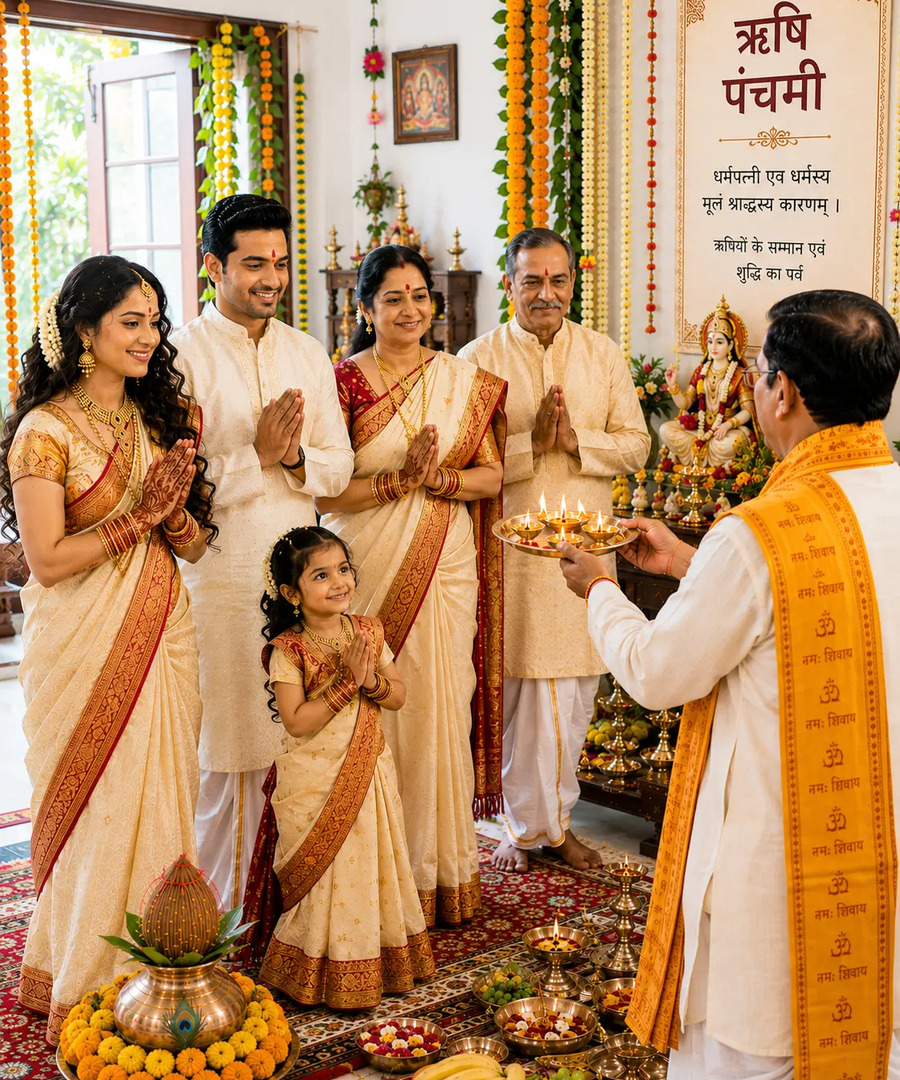
Traditional worship of the seven sages, the Sapta Rishis — verified image awaiting upload
01 / 05
Worship of the Sapta Rishis
सप्तऋषि पूजन
Observe in your own way. Fasting is voluntary and never medically necessary. Menstruation is a normal biological process — it does not make anyone impure or less worthy of worship.
Panchang · New Delhi, India · Asia/Kolkata
Panchang data unavailable—please verify with your local Panchang.
Panchang data unavailable—please verify with your local Panchang.
The shared verified calendar reads the rolling current year plus nine years. No licensed Panchang provider is connected, so missing dates, sunrise, sunset and puja periods are never estimated. When Panchami spans two civil dates, the date follows the convention stated in the verified record's notes. New Delhi is this page's reference location; its timing is not universal, and city selection is not currently available.
Rishi Panchami is kept separate from Nag, Vasant and Vivah Panchami — a record for any of those is never shown here. Many Panchangs use the madhyahna-vyapini rule (Panchami prevailing at midday) rather than the sunrise tithi; when regional Panchangs give different dates, the verified record notes state which tradition is followed.
ऋषि पंचमी पूजा विधि
Regional and family practices vary; none of these steps is a universal requirement. No mantras are prescribed here — follow a family elder, priest or trusted puja book. Anyone may take part, including people who are menstruating, according to their own beliefs and comfort.
Clean and prepare the puja area.
Bathe or freshen up according to your comfort and household custom.
Arrange images, symbols or written names of the seven sages. Some families make seven small mounds or betel nuts to represent them.
Include Arundhati alongside the sages where this is part of your family’s tradition.
Offer flowers, sandalwood, akshat, water, a diya and incense according to custom.
Offer fruits, suitable naivedya and other traditional offerings.
Recite or listen to the Rishi Panchami Vrat Katha.
Offer respectful prayers to Kashyapa, Atri, Bharadvaja, Vishvamitra, Gautama, Jamadagni, Vasishtha.
Complete the puja with aarti if customary and distribute prasad according to household custom.
पूजा सामग्री सूची
Tick items as you prepare; progress is saved on this device. Optional and tradition-specific items are marked.
0 of 16 items prepared16 में से 0 सामग्री तैयार
Items depend on family, region and the chosen puja; optional items are not universal requirements. · सामग्री परिवार, क्षेत्र और चुनी हुई पूजा अनुसार बदलती है।
व्रत, भोजन और प्रसाद
Some households eat one simple meal using foods traditionally associated with unploughed land — such as certain grains, greens, roots, tubers or millets (for example, Maharashtra’s rishichi bhaji). Others keep a phalahar fast or no fast at all. No single menu is mandatory.
Wash and cook all vegetables properly. Never eat unidentified wild greens or plants; buy from trusted sources.
A strict or waterless fast is not required. Prayer, katha and gratitude are complete observance.
Pregnant people, children, older adults and anyone with medical conditions or medication schedules affected by fasting should prioritise health and consult a healthcare professional when needed. Do not ignore dizziness, weakness, dehydration or hunger — eat and drink, and seek help if symptoms persist.
Seasonal fruits, a simple homemade sweet, or a sattvik dish prepared hygienically are suitable offerings. Share prasad with family, elders and anyone in need.
आध्यात्मिक महत्व
The day is an occasion to thank the sages whose insight shaped spiritual and cultural traditions.
Many families extend that gratitude to their own teachers, mentors and elders.
Reading, studying or teaching something meaningful honours the Rishis’ legacy of learning.
The observance invites honest self-reflection and steady, disciplined living.
Charity, kindness and ethical conduct make the observance meaningful whether or not one fasts.
बारह राशियों के लिए चिंतन
Traditional spiritual reflection, not a scientific or guaranteed prediction. No marriage, health, wealth, career or future outcome is promised.
सम्मानपूर्ण पालन और सावधानियाँ
Keep diyas on heat-resistant surfaces away from cloth and flowers; never leave flames unattended, and ventilate rooms with incense.
Wash, cook and store naivedya hygienically; avoid unidentified wild plants.
If bathing at a river or pond is customary, use only safe, designated ghats; never enter deep or fast-flowing water. Bathing at home is equally respectful.
Handle sandalwood, camphor and other materials carefully, keep them away from children, and compost flowers afterwards.
Menstruation is a normal biological process — not a disease, a sin or evidence of spiritual inferiority. Nobody should be shamed for menstruating.
Worship and participation can be adapted to personal beliefs, comfort and health. Do not shame anyone who chooses not to fast or follows different family customs.
The Vrat Katha is a traditional devotional narrative; its purity beliefs are historical religious views, not medical facts. No dates, mantras or images were invented for this page; the existing artwork is illustrative.