Bhadrapada Shukla Tritiya · Shiva-Parvati · Vrat Katha

Hartalika Teej – हरतालिका तीज

A devotional observance remembering Goddess Parvati’s tapasya and her steadfast devotion to Lord Shiva. Devotees pray to Shiva and Parvati, hear the Vrat Katha and, by personal choice, may fast — honouring devotion, determination and companionship, without any promise of guaranteed outcomes.

Next Hartalika Teej · Panchang data unavailable—please verify with your local Panchang. · Bhadrapada Shukla Tritiya · New Delhi, India

Image placeholder — to be replaced

Goddess Parvati performing tapasya in devotion to Lord Shiva — verified image awaiting upload

01 / 05

Parvati’s tapasya

माँ पार्वती की तपस्या

Fasting is voluntary. A nirjala fast is never medically necessary. Prayer and katha alone are complete observance; pregnant people, children, older adults and anyone with a medical condition should prioritise health and seek medical advice.

Hartalika Teej Vrat Katha & History

A sacred narrative, not a historical record

The Hartalika Teej Vrat Katha is a traditional devotional story found in Puranic-style retellings and family recitations. It is cherished as a story of faith; it is not an independently verified historical event, and versions differ between regions.

Parvati’s devotion

In the tradition, Goddess Parvati, daughter of Himavan, resolved from a young age to have Lord Shiva as her companion and devoted herself to him in prayer.

A proposed marriage

The katha relates that her father, encouraged by the sage Narada, agreed to give Parvati in marriage to Lord Vishnu. Parvati was distressed because her heart was set on Shiva.

A friend’s support

Parvati confided in a close friend (sakhi). Her friend helped her leave home and took her to a forest, where she could continue her devotion undisturbed.

Tapasya in the forest

There Parvati undertook intense tapasya. Many retellings describe her shaping a Shiva linga from sand or clay on Bhadrapada Shukla Tritiya and worshipping it through the night with devotion.

Shiva grants her wish

Moved by her steadfastness, Lord Shiva appeared and accepted her wish to be his consort. Her father later agreed to the marriage.

The meaning of “Hartalika”

A traditional interpretation joins “harit” (taken away) and “aalika” (female friend) — recalling the friend who took Parvati away to the forest. This is a customary folk explanation of the name rather than a settled linguistic finding.

Where it is observed

Hartalika Teej is widely observed in Uttar Pradesh, Bihar, Jharkhand, Madhya Pradesh, Rajasthan, Chhattisgarh, Maharashtra and Nepal, among other places. Fasting rules, idols, songs and the concluding puja vary by community and family.

Hartalika Teej Date, Tithi & Puja Muhurat

Panchang · New Delhi, India · Asia/Kolkata

Panchang data unavailable—please verify with your local Panchang.

Observance
Bhadrapada Shukla Tritiya
Verified local tithi
Not verified
Tritiya begins
Not verified
Tritiya ends
Not verified
Local sunrise
Not verified
Local sunset
Not verified
Puja muhurat
Not verified
Parana (next day, after Tritiya ends)
Not verified
Tradition & notes
Not verified

Panchang data unavailable—please verify with your local Panchang.

The shared verified calendar reads the rolling current year plus nine years. No licensed Panchang provider is connected, so missing dates, sunrise, sunset, muhurat and Parana are never estimated. When Tritiya spans two civil dates, the date follows the convention stated in the verified record's notes. New Delhi is this page's reference location; its timing is not universal, and city selection is not currently available.

Hartalika Teej is kept separate from Hariyali and Kajari Teej — a record for either of those is never shown here.
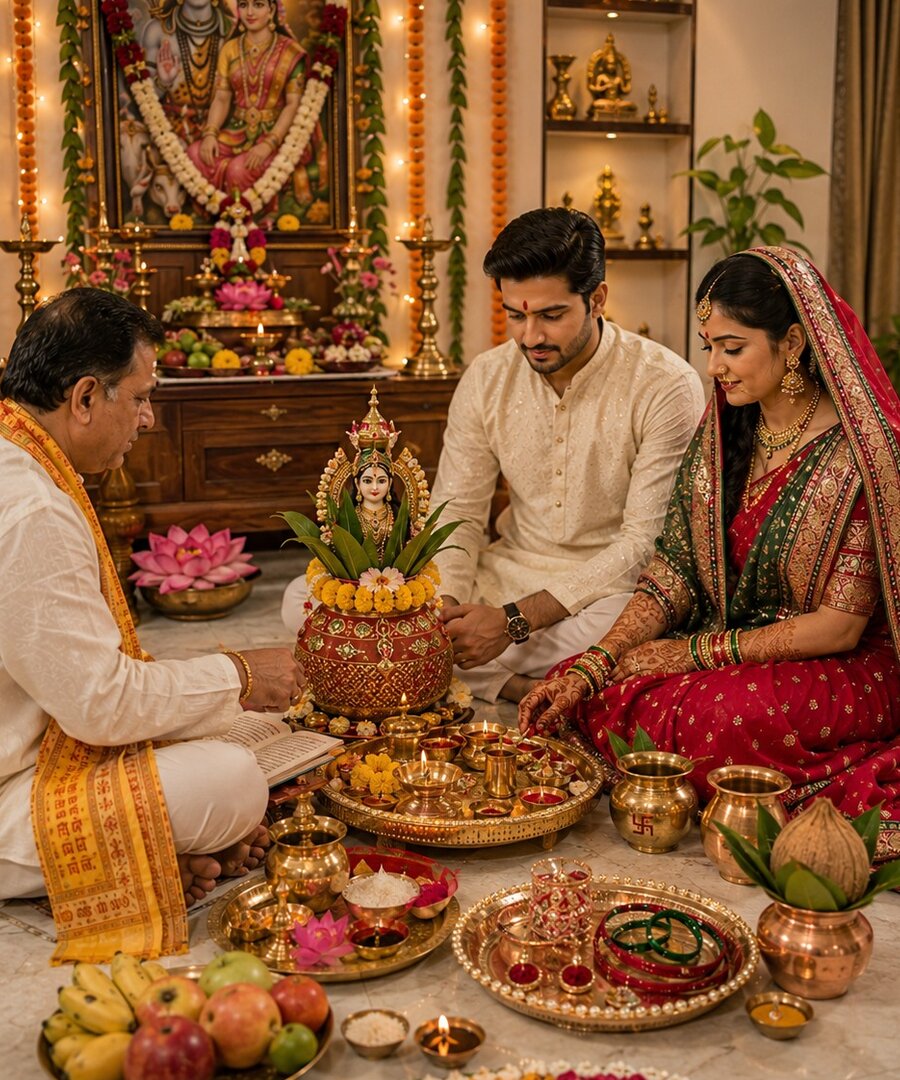
Hartalika Teej Puja Vidhi

हरतालिका तीज पूजा विधि

Customs differ across regions and families. Clay or sand idols, night vigils and shringar offerings are regional practices; no household must perform identical rituals.

  1. 1

    Prepare the altar

    Clean the puja area and set a chowki with a clean cloth.

  2. 2

    Personal preparation

    Bathe and prepare for worship according to your family custom.

  3. 3

    Arrange Shiva and Parvati

    Place idols or images of Shiva and Parvati. In many households, temporary figures are lovingly shaped from clay or sand — this is optional and region-specific.

  4. 4

    Ganesha first (if customary)

    Many households begin by worshipping Lord Ganesha; follow your own tradition.

  5. 5

    Offerings

    Offer flowers, leaves (such as bel patra where available), a diya, incense and other offerings suitable in your family.

  6. 6

    Shiva-Parvati puja

    Worship Shiva and Parvati together. Where customary, adornment items (shringar) are offered to Goddess Parvati.

  7. 7

    Vrat Katha

    Listen to or read the Hartalika Teej Vrat Katha from a trusted family or temple source.

  8. 8

    Bhajans or vigil (optional)

    Some devotees sing bhajans or keep a night vigil (jagran). It is a choice, not a requirement; rest is equally respectful.

  9. 9

    Aarti and bhog

    Perform aarti and offer bhog/prasad.

  10. 10

    Next morning

    Many families perform a concluding puja the following morning, respectfully immerse temporary clay or sand idols (ideally in a bucket or garden water rather than rivers), and then complete the fast as their tradition directs. Follow your local Panchang and family elders for timing.

Interactive Puja Samagri Checklist

पूजा सामग्री सूची

Tick items as you prepare; progress is saved on this device. Optional and regional items are marked.

0 of 15 items prepared15 में से 0 सामग्री तैयार

Items depend on family, region and the chosen puja; optional items are not universal requirements. · सामग्री परिवार, क्षेत्र और चुनी हुई पूजा अनुसार बदलती है।

Vrat, Bhog & Prasad

व्रत, भोग और प्रसाद

Traditional fasting

Some communities observe a strict nirjala fast (without food or water) from one sunrise to the next. Others keep a phalahar fast, a partial fast, or observe with prayer alone. Every form of sincere observance is respected.

Never medically necessary

A nirjala fast is a personal devotional choice. It is never medically necessary and is not suitable for everyone.

Safer alternatives

A non-nirjala fast with water, fruit and milk, a single simple meal, or a devotional observance without fasting are all valid ways to honour the day.

Who should prioritise health

Pregnant or breastfeeding people, children, older adults, and anyone with a medical condition or medicines that require food or fluids should prioritise their health and seek appropriate medical advice before fasting.

Listen to your body

Do not ignore thirst, dizziness, weakness, fainting or signs of dehydration. Drink water and eat, and seek medical help if symptoms persist. Stopping a fast for health is not a failure of devotion.

Bhog and prasad

Commonly offered items include seasonal fruits, coconut, homemade sweets and household-specific bhog such as thekua, gujiya or kheer. Offer what your family traditionally prepares, made hygienically.

The heart of the day

Prayer, katha and devotion are the core of the observance; food rules are an expression of that devotion, not its measure.

Spiritual Significance

आध्यात्मिक महत्व

Devotion and determination

Parvati’s tapasya is remembered as an example of sincere devotion and steady determination.

Personal choice

The katha honours Parvati’s right to choose her own path — a theme many devotees find meaningful today.

Companionship and friendship

The friend who supported Parvati reminds us of the value of loyal friendship.

Marital harmony and commitment

Shiva-Parvati worship is traditionally associated with harmony and spiritual commitment in relationships. It is a prayerful hope, not a guarantee of marriage, a spouse’s longevity, fertility, wealth or any outcome.

Married and unmarried devotees

Both married and unmarried devotees observe Hartalika Teej in many communities. Each person’s choice to observe — or not — deserves respect.

12 Rashi Guidance & Puja Impact

बारह राशियों के लिए चिंतन

Traditional spiritual reflection, not a scientific or guaranteed prediction. No marriage, relationship, health, wealth, career or future outcome is promised.

Mesh (Aries) · मेष

Traditional guidance
Turn bold energy into patient devotion today.
Prayer or practice
Offer a single flower to Parvati with a quiet sankalp of patience.
Spiritual lesson
Like Parvati’s tapasya, real resolve is steady rather than hurried.
Positive action
Finish one task you have been rushing, slowly and well.

Vrishabh (Taurus) · वृषभ

Traditional guidance
Find devotion in simple, wholesome offerings.
Prayer or practice
Prepare a modest homemade bhog with gratitude.
Spiritual lesson
Sincerity matters more than abundance in worship.
Positive action
Share prasad with someone who lives alone.

Mithun (Gemini) · मिथुन

Traditional guidance
Let words serve devotion and kindness.
Prayer or practice
Read or listen to the Vrat Katha attentively, without distraction.
Spiritual lesson
Parvati’s friend shows how a supportive voice can change a life.
Positive action
Send an encouraging message to a friend facing a hard choice.

Kark (Cancer) · कर्क

Traditional guidance
Nurture the home as a space of peace.
Prayer or practice
Light a diya at the family altar and pray for everyone’s wellbeing.
Spiritual lesson
Care given gently strengthens family bonds.
Positive action
Help an elder or family member with the puja preparations.

Singh (Leo) · सिंह

Traditional guidance
Lead with humility in the puja.
Prayer or practice
Bow before Shiva-Parvati and set aside pride for a few minutes.
Spiritual lesson
True strength includes the courage to be humble.
Positive action
Give someone else credit for work you shared.

Kanya (Virgo) · कन्या

Traditional guidance
Bring mindful care to the altar.
Prayer or practice
Arrange the samagri neatly as an act of meditation.
Spiritual lesson
Order and cleanliness can steady the mind for prayer.
Positive action
Choose eco-friendly clay and avoid plastic decorations.

Tula (Libra) · तुला

Traditional guidance
Seek balance between devotion and self-care.
Prayer or practice
Pray for harmony in all your relationships, not only one.
Spiritual lesson
Shiva and Parvati are often seen as a symbol of balance and partnership.
Positive action
If fasting strains you, choose a gentler observance without guilt.

Vrishchik (Scorpio) · वृश्चिक

Traditional guidance
Transform intensity into inner focus.
Prayer or practice
Sit for a short silent meditation on Shiva before aarti.
Spiritual lesson
Deep feeling, directed inward, can become steadfast faith.
Positive action
Let go of one grudge in your heart today.

Dhanu (Sagittarius) · धनु

Traditional guidance
Learn from the wisdom of the katha.
Prayer or practice
Reflect on one teaching from Parvati’s journey and write it down.
Spiritual lesson
Faith grows when we understand the stories we honour.
Positive action
Explain the meaning of the festival to a younger family member.

Makar (Capricorn) · मकर

Traditional guidance
Honour commitments with quiet discipline.
Prayer or practice
Offer bel patra or leaves with a promise to keep one healthy habit.
Spiritual lesson
Patient effort, like tapasya, builds over time.
Positive action
Plan a realistic routine you can sustain this month.

Kumbh (Aquarius) · कुंभ

Traditional guidance
Celebrate community and togetherness.
Prayer or practice
Join a family or neighbourhood bhajan, in person or by call.
Spiritual lesson
Shared devotion connects people across differences.
Positive action
Include someone who might otherwise celebrate alone.

Meen (Pisces) · मीन

Traditional guidance
Let compassion guide your prayers.
Prayer or practice
Sing or listen to a favourite Shiva-Parvati bhajan with an open heart.
Spiritual lesson
Gentle devotion is as sacred as strict ritual.
Positive action
Do one quiet act of kindness without telling anyone.

Precautions & Inclusive Celebration

सावधानियाँ

Diya and incense

Place diyas on heat-resistant surfaces away from curtains, saris and children; never leave flames unattended overnight. Ventilate rooms when burning incense.

Decorative lights

Use certified electrical lights, avoid overloaded sockets and switch decorations off when unattended.

Food hygiene

Prepare bhog hygienically, refrigerate perishables and break the fast with light, easily digestible food.

Temples and gatherings

Be patient in queues, respect temple rules and keep a watch on children and elders in crowds.

Fasting is voluntary

Adapt the observance to your health and circumstances. Nobody should be shamed for not fasting or for following a different family tradition.

Eco-friendly immersion

Immerse temporary clay or sand idols at home in a bucket or garden rather than rivers or lakes.

Frequently Asked Questions About Hartalika Teej

Related Festivals

Sources & Tradition Notes

The Vrat Katha is a traditional devotional narrative. No dates, mantras or images were invented for this page; the existing artwork is illustrative.

Observe Hartalika Teej with devotion