Lord Shiva · Devotion & night-long worship

Maha Shivaratri

महाशिवरात्रि

The great night of Lord Shiva, observed on Krishna Paksha Chaturdashi with prayer, Shiva Lingam worship, optional fasting and night-long vigil through the four prahars and Nishita Kaal. Customs vary by family and region; timings should follow a trusted local Panchang.

Upcoming date not verified · New Delhi, India

Book Pandit Ji
Existing image of a framed traditional painting of Lord Shiva seated in meditation, garlanded with marigolds

01 / 05

Lord Shiva in devotional depiction

भगवान शिव

Story & History of Maha Shivaratri

The great night of Shiva

Maha Shivaratri, “the great night of Shiva”, is widely observed on the Chaturdashi (fourteenth lunar day) of Krishna Paksha in the month of Phalguna by the Purnimanta reckoning used in much of North India, which corresponds to Magha in the Amanta reckoning followed in many southern and western regions. It is the most prominent of the monthly Shivaratri observances.

The appearance of the Lingam of light

One traditional account, found in Puranic literature, describes a dispute between Brahma and Vishnu about supremacy that was resolved when a boundless pillar of light appeared. Neither could find its beginning or end, and Shiva was revealed as that infinite light. Many devotees associate Maha Shivaratri with this appearance and understand the Shiva Lingam as a symbol of the formless, limitless divine.

Shiva and Parvati

In many households and regions, Maha Shivaratri is remembered as the night of the divine marriage of Lord Shiva and Goddess Parvati, celebrated after Parvati’s long tapasya. Temples in several places hold wedding processions and celebrations. Other traditions emphasise different meanings, and these accounts are not identical everywhere.

The cosmic dance

Some devotees, particularly in traditions honouring Shiva as Nataraja, associate the night with Shiva’s cosmic dance of creation, preservation and dissolution. Classical dance festivals held near certain temples on Maha Shivaratri draw from this devotional imagery. This is a traditional religious account rather than a historical event.

Other remembered accounts

Folk narratives also recall a hunter who, staying awake in a bilva tree through the night, unknowingly let leaves and water fall upon a Lingam below and received grace. Accounts of Shiva holding the poison from the churning of the ocean are linked by some communities with night-long vigil. Such stories are shared for devotion and reflection, and their details differ across texts and regions.

Observance across India and beyond

Devotees visit Jyotirlinga and local Shiva temples, offer water and bilva leaves, chant, sing bhajans and keep vigil according to their capacity. Customs in Kashmir (Herath), Gujarat, Maharashtra, Tamil Nadu, Nepal and elsewhere have distinct regional forms. No single description captures every community’s practice.

Maha Shivaratri Date, Tithi & Muhurat

New Delhi, India · Asia/Kolkata

Upcoming date not verified

Hindu month & Paksha
Phalguna (Purnimanta) / Magha (Amanta) · Krishna Paksha (tradition; local occurrence requires verification)
Chaturdashi Tithi
Not verified
Chaturdashi begins
Not verified
Chaturdashi ends
Not verified
Nishita Kaal Puja Muhurat
Not verified — consult your local Panchang
Four Prahar Puja timings
Not verified — requires validated local sunset and sunrise
Next-day Parana
Not verified — consult your local Panchang
Regional observance rule
Requires the night on which Chaturdashi prevails at Nishita Kaal, plus local sunrise and Amanta/Purnimanta conventions

No verified upcoming occurrence is available. Automatic Panchang synchronization is not connected; consult your local Panchang.

New Delhi is the service reference, not your detected location. Maha Shivaratri requires validated local Chaturdashi, Nishita Kaal, sunset/sunrise and regional conventions; the generic regional-calendar label alone does not calculate these rules. Verified ten-year provider coverage is not connected; no Gregorian recurrence or another festival’s date is substituted.
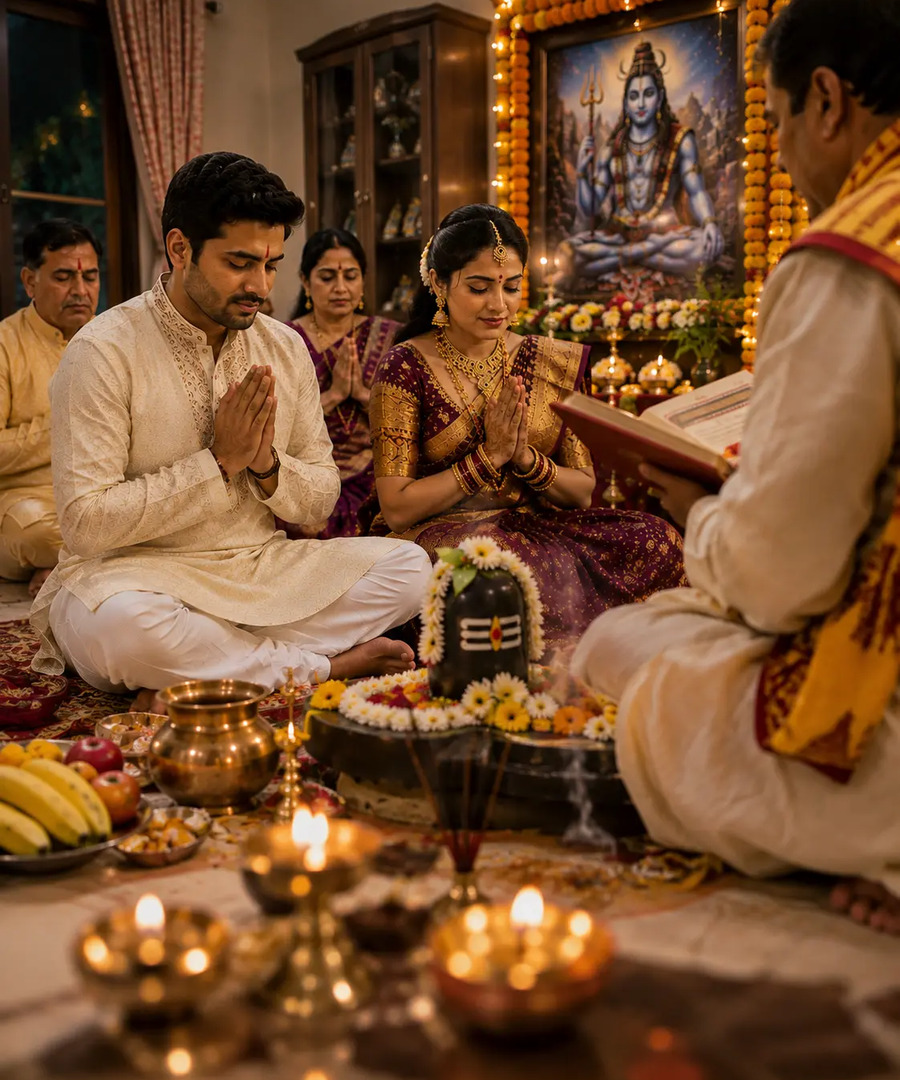
Maha Shivaratri Puja Vidhi

परंपरा अनुसार महाशिवरात्रि पूजा विधि

Choose the practices appropriate to your family, region and sampradaya. Not every devotee needs to perform every step.

  1. 1

    Prepare with intention

    Clean the home shrine, bathe and wear clean clothes. Some devotees take a sankalpa (resolve) for the fast and worship in the morning; choose a resolve suited to your health and circumstances.

  2. 2

    Arrange the altar

    Place a Shiva Lingam or an image of Lord Shiva (and Parvati, if your family does so) on a clean cloth or puja thali. Keep water, flowers, bilva leaves, a diya and incense ready.

  3. 3

    Offer water (jal abhishek)

    Gently pour clean water over the Lingam, or offer it before an image. Many families use a copper or brass lota. Avoid wasting water and dispose of it respectfully, for example into plants.

  4. 4

    Traditional offerings where appropriate

    Some traditions offer milk, curd, honey, ghee or sugar (panchamrit), or Ganga jal. Follow your family and temple guidance; offerings are not required, and many temples request limited quantities to avoid waste.

  5. 5

    Bilva leaves and flowers

    Offer clean bilva leaves — traditionally the three-leaflet form — along with white or seasonal flowers. Many offer bilva with the smooth side facing the Lingam. Use only leaves gathered responsibly.

  6. 6

    Light the diya and incense

    Light a ghee or oil diya and incense in a safe, stable place away from cloth, flowers and children’s reach.

  7. 7

    Prayer and chanting

    Pray in your own words or chant a mantra received from your family, guru or temple tradition, such as the widely known Panchakshari “Om Namah Shivaya”. Recite stotras only from reliable printed sources.

  8. 8

    Night worship and the four Prahars

    Some devotees worship four times through the night — once in each prahar (roughly one quarter of the night between local sunset and sunrise), with a fresh abhishek each time. Nishita Kaal, the midnight period, is regarded by many traditions as the most auspicious time for Shiva worship. Exact windows depend on your location and must come from a local Panchang.

  9. 9

    Aarti and vigil (jagaran)

    Conclude each worship with aarti. Staying awake is a devotional practice, not an obligation; rest when you need to, and keep vigil in a way that is safe for you.

  10. 10

    Parana — completing the fast

    Those who fast usually break it the next morning after sunrise and before Chaturdashi ends, or as advised by their Panchang and family custom. Begin with light, simple food and water. Traditions about Parana timing vary.

Maha Shivaratri Puja Samagri

चुनी हुई पूजा की सामग्री

Materials depend on family and regional traditions; choose what suits your practice. Optional items can be omitted.

0 of 14 items prepared14 में से 0 सामग्री तैयार

Items depend on family, region and the chosen puja; optional items are not universal requirements. · सामग्री परिवार, क्षेत्र और चुनी हुई पूजा अनुसार बदलती है।

Spiritual Significance of Maha Shivaratri

भक्ति, संयम और चिंतन

Devotion to Lord Shiva

Maha Shivaratri is a night dedicated to remembering Shiva as the auspicious, compassionate and transcendent divine. For many devotees it is a time to renew a personal relationship with Shiva through simple, sincere worship.

Self-discipline and restraint

Fasting, simplicity in food and speech, and staying alert are understood as practices that steady the mind. Their value lies in sincerity and balance, not in hardship beyond one’s capacity.

Reflection and inner stillness

The darkness of the Chaturdashi night is often described as an invitation to turn inward — to let go of what clouds the mind and reflect quietly, through meditation, japa or silence.

Night-long worship

Worship across the four prahars and at Nishita Kaal expresses continuous remembrance of the divine. Communities keep vigil with bhajans, readings and temple worship; individuals participate as they are able.

The Shiva Lingam

In Shaiva tradition the Lingam is a sacred symbol of Shiva’s formless, infinite nature, often linked with the account of the boundless pillar of light. Its worship is understood as devotion to the divine beyond any single form.

Prayer, gratitude and service

Prayer, gratitude, kindness and helping others — including sharing prasad or food — are part of the spirit of the night. Spiritual practice is offered with devotion; it does not guarantee wealth, health, marriage or any material result.

12 Rashi Guidance & Puja Impact

बारह राशियों के लिए आध्यात्मिक चिंतन

Optional Maha Shivaratri reflections arranged by traditional zodiac names, not a scientifically established prediction or a Rashi-specific religious rule. Anyone may choose any suitable practice; no future outcome is promised.

Mesh (Aries)

Guidance
Let the night temper restless energy: begin worship slowly and offer each bilva leaf with full attention.
Devotional significance
Shiva as the still centre amid action is a reminder that strength grows through restraint.
Suggested practice
Offer water silently for a few minutes before chanting.
Personal reflection
Where do I act in haste, and what could patience change?

Vrishabh (Taurus)

Guidance
Keep the offerings simple and seasonal, valuing sincerity over abundance.
Devotional significance
Simplicity in worship reflects the ascetic Shiva who needs nothing yet accepts devotion.
Suggested practice
Share fruit or prasad with someone in need the next day.
Personal reflection
Which comforts could I hold more lightly?

Mithun (Gemini)

Guidance
Quiet the flow of words: choose one prayer or mantra from your tradition and stay with it.
Devotional significance
Focused japa is traditionally valued above scattered effort.
Suggested practice
Spend part of the evening in silence, away from phone screens.
Personal reflection
What thoughts keep returning when I sit still?

Kark (Cancer)

Guidance
Include family in a gentle evening aarti, letting elders and children take part comfortably.
Devotional significance
Shiva and Parvati are remembered together, honouring care and companionship in the home.
Suggested practice
Light the diya together and offer a family prayer.
Personal reflection
How can I care for others without neglecting myself?

Singh (Leo)

Guidance
Offer worship with humility, perhaps quietly helping at a temple rather than leading.
Devotional significance
Before the infinite pillar of light, every sense of importance becomes small.
Suggested practice
Volunteer for queue, cleaning or water service where welcome.
Personal reflection
Where would humility make me a better leader?

Kanya (Virgo)

Guidance
Prepare the altar carefully, but let go of perfectionism once worship begins.
Devotional significance
Devotion, not precision alone, is at the heart of the Hunter’s story.
Suggested practice
Keep a calm, tidy puja space and dispose of offerings responsibly.
Personal reflection
Can I accept imperfection in myself and others?

Tula (Libra)

Guidance
Reflect on harmony, remembering the balance of Shiva and Shakti in the Ardhanarishvara form.
Devotional significance
Many traditions see Shiva and Parvati as inseparable complementary principles.
Suggested practice
Mend one strained relationship with a kind message or apology.
Personal reflection
Where do I need more balance between giving and receiving?

Vrishchik (Scorpio)

Guidance
Use the night’s introspective mood to release an old resentment in prayer.
Devotional significance
Shiva holding poison in his throat is remembered as transforming harm without spreading it.
Suggested practice
Write down something you wish to let go and reflect on it during Nishita Kaal.
Personal reflection
What am I holding onto that harms my peace?

Dhanu (Sagittarius)

Guidance
Read or listen to a Shiva katha from a reliable source and contemplate one teaching.
Devotional significance
Learning and contemplation are long-standing companions to vigil.
Suggested practice
Discuss a story of Shiva with family or friends.
Personal reflection
Which teaching do I want to carry into the coming months?

Makar (Capricorn)

Guidance
Approach the observance steadily; keep a fast or vigil only to a degree that is sustainable.
Devotional significance
Shiva as the great yogi represents disciplined effort without strain.
Suggested practice
Plan rest and hydration as carefully as worship.
Personal reflection
Is my discipline rooted in devotion or in pressure?

Kumbh (Aquarius)

Guidance
Think of the wider community — temple volunteers, pilgrims and those unable to attend.
Devotional significance
Shiva’s ganas include all beings, reflecting inclusiveness in devotion.
Suggested practice
Help an elderly neighbour join worship safely or bring them prasad.
Personal reflection
How can my devotion become service to others?

Meen (Pisces)

Guidance
Let bhajan, music or meditation carry you into a gentle stillness during the night.
Devotional significance
Many devotees experience the night as surrender to Shiva’s compassion.
Suggested practice
Sit quietly by the diya for a few minutes after aarti.
Personal reflection
What would it mean to trust more and worry less?

Maha Shivaratri Precautions & Practical Tips

सुरक्षा और व्यावहारिक मार्गदर्शन

Confirm local timings

Chaturdashi, Nishita Kaal, prahar and Parana windows change with location and local sunrise/sunset. Check a trusted local Panchang or your temple before planning.

Fasting safely

Fasting is a personal choice and not compulsory. Pregnant or nursing women, children, elderly people and anyone with diabetes, low blood pressure or other health conditions should consult a doctor and may choose fruit, milk or simply prayer instead.

Hydration and rest

Drink enough water if your fast permits it, avoid long exposure to heat or cold in queues and rest when tired. No one must remain awake all night; a partial vigil or a single night-time prayer is meaningful.

Safe diya use

Place lamps on stable, non-flammable surfaces, away from curtains, flowers, loose clothing and children. Never leave diyas unattended while sleeping.

Responsible temple visits

Follow crowd instructions, keep children and elders close, protect valuables, and avoid peak rush if you have health concerns. Respect temple rules about offerings and photography.

Mindful offerings

Offer milk and other foods in small quantities and support temples that donate or recycle offerings. Use responsibly gathered bilva leaves and dispose of flowers through compost or designated bins.

Travel at night

Plan transport in advance, travel in groups where possible and keep emergency contacts handy.

Frequently Asked Questions About Maha Shivaratri

Related Festivals

Sources & Tradition Notes

These sources describe Panchang guidance and religious or cultural traditions; links alone do not verify an upcoming local occurrence. Shiva worship, prahar pujas, offerings and temple celebrations have regional and family variations. No scripture quotation or historical origin date is invented here.

Observe the great night with devotion and care

Confirm your location’s Panchang and chosen tradition before planning time-sensitive observances.