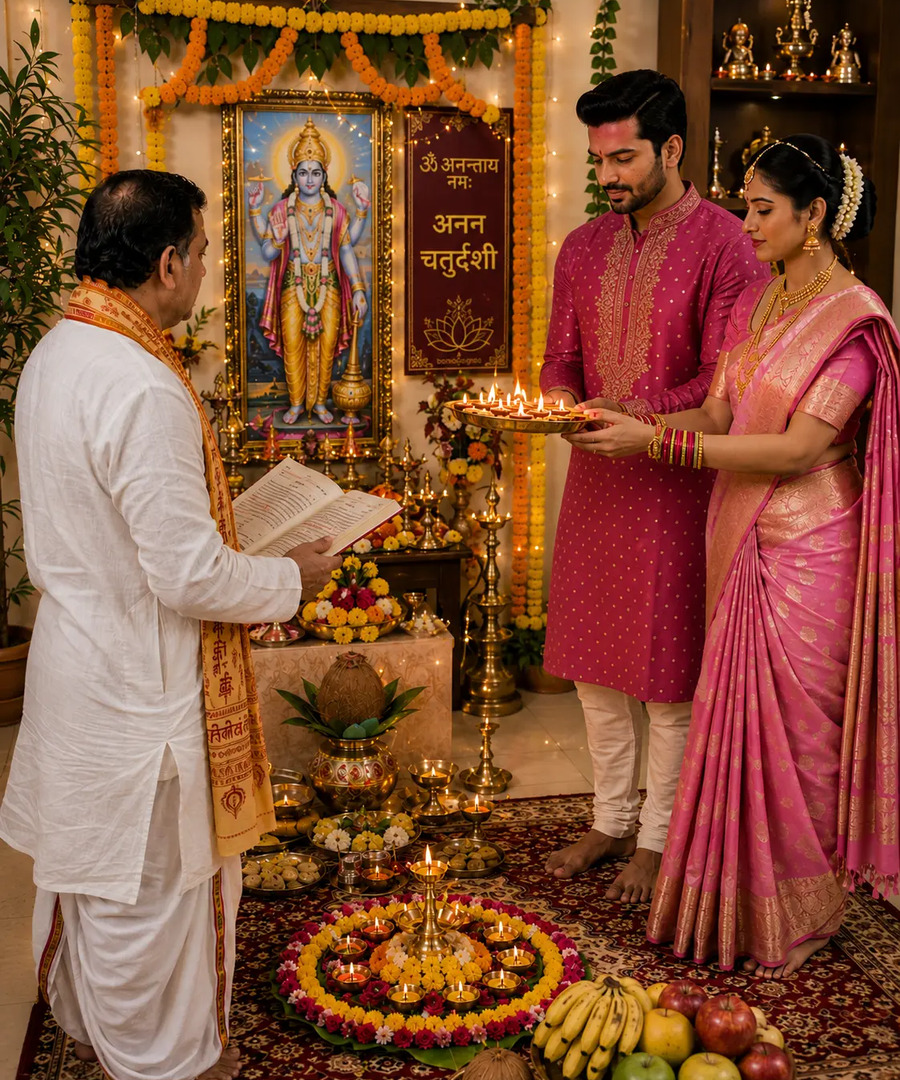
A traditional narrative
The Anant Chaturdashi Vrat Katha is recited in many households and is commonly associated with the Bhavishya Purana tradition. Versions vary between retellings; it is a devotional story, not a historically verified event.
Bhadrapada Shukla Chaturdashi · Anant Padmanabha · Ganesh Visarjan
A vrat honouring Lord Vishnu as Anant Padmanabha, the infinite, with worship of the sacred fourteen-knot Anant Sutra. In many communities it is also the day Ganeshotsav concludes with Ganesh Visarjan — while other families complete Visarjan earlier by their own custom.
Next Anant Chaturdashi · Panchang data unavailable—please verify with your local Panchang. · Bhadrapada Shukla Chaturdashi · New Delhi, India
Image placeholder — to be replaced
Lord Vishnu in the Anant Padmanabha form resting on Shesha — verified image awaiting upload
01 / 05
Anant Padmanabha on Shesha
शेषशायी अनंत पद्मनाभ
Fasting is optional. Strict or waterless fasting is not necessary for everyone; prayer and katha are complete observance. The Anant Sutra is a devotional symbol, not a guarantee of protection or success.
Panchang · New Delhi, India · Asia/Kolkata
Panchang data unavailable—please verify with your local Panchang.
Panchang data unavailable—please verify with your local Panchang.
The shared verified calendar reads the rolling current year plus nine years. No licensed Panchang provider is connected, so missing dates, sunrise, sunset, puja period, Visarjan and Parana are never estimated. When Chaturdashi spans two civil dates, the date follows the convention stated in the verified record's notes. New Delhi is this page's reference location; its timing is not universal, and city selection is not currently available.
Most Panchangs observe Anant Chaturdashi on the day Chaturdashi prevails at sunrise (Udaya tithi), but regional conventions can differ by a day; the verified record notes state which tradition is followed.
अनंत चतुर्दशी पूजा विधि
Common practices are listed; regional customs differ. No mantras or compulsory steps are prescribed here — follow your family, priest or community.
Clean the puja area and prepare a chowki with a clean cloth.
Place an image or murti of Lord Vishnu in his Anant Padmanabha form.
Arrange the kalash and puja materials according to household tradition.
Take a devotional sankalp for the vrat if you follow this practice.
Offer water, flowers, sandalwood, akshat, a diya and incense.
Prepare and worship the Anant Sutra, a thread traditionally tied with fourteen knots and regarded as a sacred devotional symbol.
Customarily the thread is tied on the wrist or upper arm. Many communities tie it on the right arm for men and the left arm for women, but practices differ — follow your family’s or community’s custom.
Recite or listen to the Anant Chaturdashi Vrat Katha.
Offer fruits, sweets and suitable naivedya.
Perform aarti and complete the puja according to your tradition.
पूजा सामग्री सूची
Tick items as you prepare; progress is saved on this device. Optional and regional items are marked.
0 of 17 items prepared17 में से 0 सामग्री तैयार
Items depend on family, region and the chosen puja; optional items are not universal requirements. · सामग्री परिवार, क्षेत्र और चुनी हुई पूजा अनुसार बदलती है।
व्रत, अनंत सूत्र और प्रसाद
Some devotees fast until the puja, others keep a phalahar fast, and some eat one simple meal, often avoiding salt in certain traditions. Many observe with prayer alone.
Fruits, kheer, sweets made with jaggery or milk, and household-specific naivedya. Offer what your family traditionally prepares.
The thread — often coloured with turmeric or kumkum — is a devotional symbol of Lord Vishnu’s infinite nature (“Anant” means endless). Its fourteen knots are linked in tradition with the fourteen lokas (realms), though interpretations differ.
The thread is a reminder of faith and commitment, not a guaranteed source of protection, wealth or success.
Prepare food hygienically, drink enough water when not fasting strictly, and break any fast gently with light food.
Strict or waterless fasting is not necessary for everyone. A devotional observance with prayer and katha, without fasting, is fully respected.
Pregnant people, children, older adults and anyone with medical conditions or medication schedules affected by food or fluids should prioritise health and seek appropriate medical advice. Do not ignore dizziness, weakness or dehydration.
गणेश विसर्जन और पर्यावरण-अनुकूल उपाय
Visarjan is a respectful farewell to Ganesha after he is welcomed and worshipped, symbolising the impermanence of form and the hope of his return the next year.
Anant Chaturdashi marks the tenth day after Ganesh Chaturthi. The large community processions popularised during the public Ganeshotsav tradition in Maharashtra conventionally conclude on this day.
Many families perform Visarjan on the 1.5th, 3rd, 5th or 7th day according to their own tradition. No single date or procedure applies to everyone.
Choose unbaked natural-clay idols with natural colours and minimal chemical decoration, avoid plastic and thermocol, and reuse decorations.
Use home buckets or tubs, or authorised artificial immersion tanks and designated sites. Follow local administration guidelines and avoid unsafe, protected or prohibited water bodies.
आध्यात्मिक महत्व
Anant Padmanabha — Vishnu resting on Shesha, the endless serpent — symbolises the infinite and the sustaining of dharma.
The vrat is a renewal of faith and devotion, offered with sincerity.
Kaundinya’s story is a reminder to recognise pride and return humbly to what is right.
The festival honours steady righteous living carried forward through generations.
Honesty, perseverance, humility and responsibility are ways to carry the festival’s spirit into daily life — as aspirations, not promises of wealth, success, health or protection.
बारह राशियों के लिए चिंतन
Traditional spiritual reflection, not a scientific or guaranteed prediction. No marriage, health, wealth, career or future outcome is promised.
सावधानियाँ और सम्मानपूर्ण उत्सव
Keep flames on heat-resistant surfaces away from cloth and flowers; never leave them unattended. Ventilate rooms with incense.
Prepare naivedya hygienically, keep prasad covered and refrigerate perishable sweets.
Follow police and organiser guidance, keep children and elders close, avoid crowd crushes and keep music and firecrackers within local rules.
Use certified lights, avoid overloaded sockets and wiring near water, and switch off decorations when unattended.
Immerse only at authorised sites; never enter deep or fast-flowing water.
Celebrate inclusively. Nobody should be shamed for not fasting or for following different customs.
The Vrat Katha is a traditional devotional narrative with varying retellings. No dates, mantras, quotations or images were invented for this page; the existing artwork is illustrative.