Krishna Paksha Ashtami · Midnight birth · Bhakti

Krishna Janmashtami / श्री कृष्ण जन्माष्टमी

The joyful celebration of Shri Krishna’s birth — a night of vigil, bhajans and loving worship of Bal Krishna, remembering devotion, compassion and the triumph of dharma.

Image placeholder — to be replaced

Krishna’s birth in the Mathura prison — verified image awaiting upload

01 / 05

Divine birth in Mathura

मथुरा में दिव्य जन्म

Krishna Janma Katha & History

Devaki, Vasudeva and Kansa

In the traditional accounts of the Bhagavata Purana and Harivamsa, King Kansa of Mathura heard a prophecy that the eighth child of his sister Devaki would end his rule. He imprisoned Devaki and her husband Vasudeva and took the lives of their children one after another — a story told to show the fear and cruelty of tyranny.

The divine birth at midnight

Krishna is traditionally said to have been born in the Mathura prison at midnight on Krishna Paksha Ashtami, under Rohini Nakshatra. Devotees describe the prison doors opening and the guards falling asleep — a sacred narrative of divine grace rather than a historical record.

Across the Yamuna

Vasudeva carried the infant across the flooded Yamuna in a basket. Tradition tells that the river parted and the serpent Shesha sheltered the child from the rain. In Gokul, Vasudeva placed Krishna with Nanda and Yashoda and returned with their newborn daughter.

Gokul and Vrindavan

Krishna grew up among cowherds, loved for his childhood leelas — stealing butter, playing the flute and protecting the community, including lifting Govardhan. These stories celebrate innocence, joy and devotion.

Nandotsav

The joy of Nanda and the Gokul villagers at Krishna’s arrival is celebrated the next day as Nandotsav. In Maharashtra and elsewhere, Dahi Handi recalls Krishna’s love of butter and curd.

Spiritual meaning

Janmashtami celebrates the belief that the divine appears to restore dharma (Bhagavad Gita 4.7–8 is often recalled in this context). Devotees keep vigil, sing bhajans and welcome Bal Krishna at midnight with love.

Janmashtami Date, Tithi & Nishita Muhurat

Panchang · New Delhi, India · Asia/Kolkata · Smarta

Panchang data unavailable—please verify with your local Panchang

Janmashtami date
Panchang data unavailable—please verify with your local Panchang
Tithi
Krishna Paksha Ashtami (Bhadrapada amanta / Shravana purnimanta) — Panchang data unavailable—please verify with your local Panchang
Ashtami begins
Panchang data unavailable—please verify with your local Panchang
Ashtami ends
Panchang data unavailable—please verify with your local Panchang
Nishita Kaal (midnight puja)
Panchang data unavailable—please verify with your local Panchang
Rohini Nakshatra
Panchang data unavailable—please verify with your local Panchang
Parana
Panchang data unavailable—please verify with your local Panchang
Nandotsav / Dahi Handi
Usually the following day — confirm locally
Notes
—

No verified upcoming occurrence is available. Automatic Panchang synchronization is not connected; consult your local Panchang.

Smarta and Vaishnava traditions can observe Janmashtami on different dates in some years. Dates and timings come only from verified, time-zoned records in the shared calendar (rolling current year plus nine years); nothing is estimated. New Delhi is the reference location; city selection is not available yet.
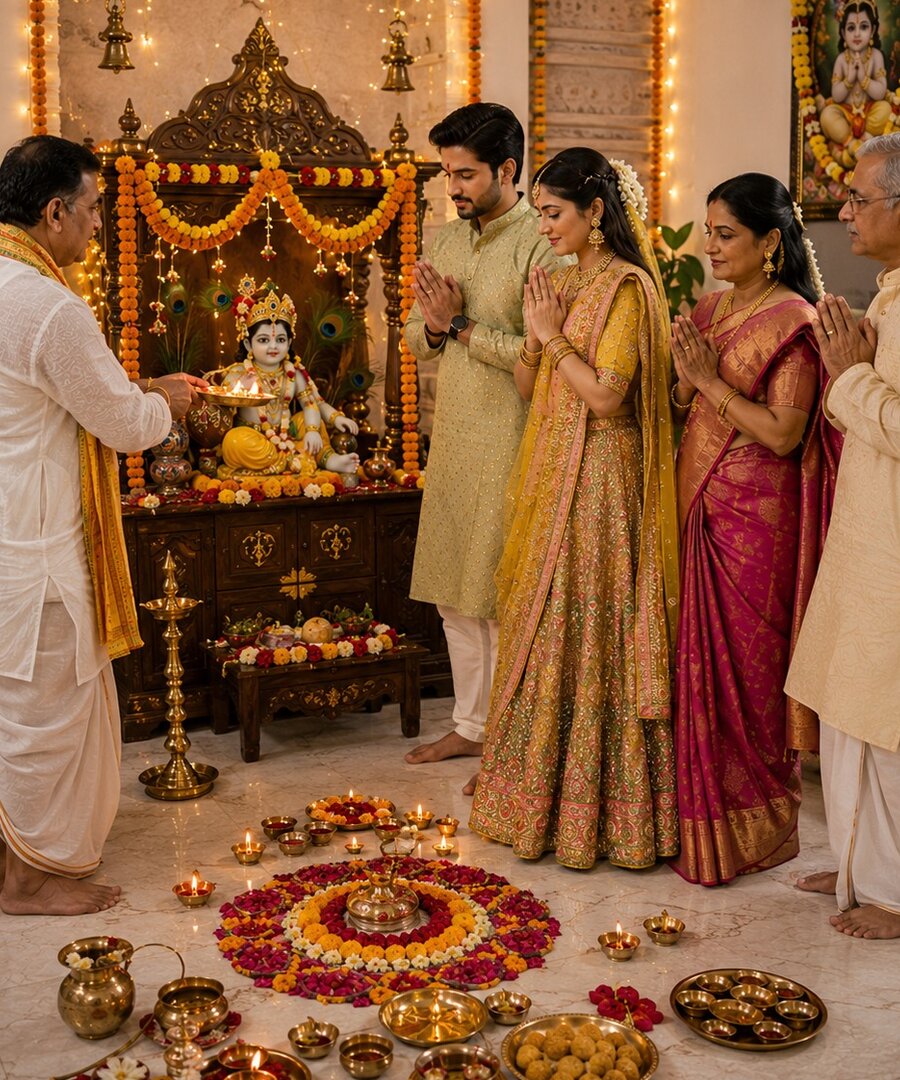
Krishna Janmashtami Puja Vidhi

जन्माष्टमी पूजा विधि

Common household practice. Abhishek, bhog and Parana customs differ by region and Sampradaya; no single custom is compulsory.

  1. 1

    Clean and prepare the altar

    Clean the puja area and set a clean cloth on the altar.

  2. 2

    Place Laddu Gopal

    Place and decorate the Laddu Gopal / Bal Krishna murti or image.

  3. 3

    Arrange jhula and samagri

    Arrange the jhula (cradle) and the puja samagri within reach.

  4. 4

    Abhishek, if customary

    If your household follows it, bathe the murti with panchamrit or clean water. Many families skip abhishek for images.

  5. 5

    Dress and adorn

    Dress and adorn Laddu Gopal respectfully with clothes, crown or flute as your family prefers.

  6. 6

    Offerings

    Offer tulsi leaves where appropriate, flowers, fruits, makhan-mishri and other customary bhog.

  7. 7

    Vrat by capacity

    Observe your chosen vrat according to personal health and family tradition — fasting is optional.

  8. 8

    Midnight celebration

    Sing bhajans, kirtan and Krishna naam-jap, and celebrate the birth during the verified local Nishita period; swing the jhula gently.

  9. 9

    Aarti and prasad

    Perform aarti, offer bhog and distribute prasad.

  10. 10

    Parana

    Break the fast according to your Sampradaya and the verified local Panchang — some after midnight puja, others the next day after Ashtami and/or Rohini end.

Puja Samagri Checklist

पूजा सामग्री सूची

Optional and tradition-specific items are marked. Progress is saved on this device.

0 of 15 items prepared15 में से 0 सामग्री तैयार

Items depend on family, region and the chosen puja; optional items are not universal requirements. · सामग्री परिवार, क्षेत्र और चुनी हुई पूजा अनुसार बदलती है।

Vrat, Bhog & Prasad

व्रत, भोग और प्रसाद

Fasting is personal

The Janmashtami vrat is a personal religious practice, not a medical requirement. Options include a phalahar (fruit and milk) fast, one simple meal, or prayer without fasting.

Foods by household tradition

Many households avoid grains during the vrat and take fruits, milk, makhana, sabudana or kuttu. Customs differ; follow your family’s practice.

Midnight bhog

At midnight, families offer makhan-mishri, panjiri (often dhaniya panjiri), fruits and panchamrit to Bal Krishna before sharing prasad.

Health first

Waterless or strict fasting is not for everyone. Children, pregnant or breastfeeding people, older adults, and anyone with a medical condition or medicines that need food or fluids should prioritise health and follow medical advice. Stop fasting if you feel unwell.

Alternatives

Those unable to fast can offer bhog, join bhajans, read the Janma Katha, serve others or donate food — devotion does not require risking health.

Spiritual Significance

आध्यात्मिक महत्व

Devotion and divine love

Janmashtami centres on bhakti — loving remembrance of Krishna, expressed through song, seva and prayer.

Dharma over tyranny

The story of Kansa and Krishna is remembered as the triumph of righteousness over fear and oppression.

Compassion and humility

Krishna’s life among cowherds reminds devotees that the divine is close to ordinary people.

Joy and innocence

Bal Krishna’s leelas invite playful, childlike joy in worship.

Teachings for daily life

Gita themes of duty without attachment, steadiness and kindness can guide everyday choices. These are spiritual reflections, not promises of outcomes.

12 Rashi Guidance & Puja Impact

बारह राशियों के लिए मार्गदर्शन

Traditional spiritual reflection, not scientific prediction. No wealth, marriage, health, career or future outcome is guaranteed.

Mesh (Aries) · मेष

Traditional guidance
Channel energy into steady seva rather than haste.
Devotional practice
Chant “Hare Krishna” slowly for a few minutes before aarti.
Spiritual lesson
Patience, as Krishna waited for the right moment to act.
Positive action
Help set up the altar or jhula for an elder.

Vrishabh (Taurus) · वृषभ

Traditional guidance
Offer simplicity and sweetness in your bhog.
Devotional practice
Prepare makhan-mishri by hand with attention.
Spiritual lesson
Contentment, like the simple life of Gokul.
Positive action
Share a portion of prasad with a neighbour.

Mithun (Gemini) · मिथुन

Traditional guidance
Let your words become kirtan.
Devotional practice
Sing or listen to one Krishna bhajan with full attention.
Spiritual lesson
Truthful, kind speech.
Positive action
Send a warm message to someone you have not spoken to in a while.

Kark (Cancer) · कर्क

Traditional guidance
Celebrate the mother’s love of Yashoda.
Devotional practice
Reflect on Yashoda’s care while rocking the jhula.
Spiritual lesson
Nurturing without control.
Positive action
Thank a parent or caregiver in person or by call.

Singh (Leo) · सिंह

Traditional guidance
Lead the celebration with humility.
Devotional practice
Let a child or elder perform the first aarti.
Spiritual lesson
Leadership as service, as Krishna served as charioteer.
Positive action
Praise someone else’s contribution publicly.

Kanya (Virgo) · कन्या

Traditional guidance
Prepare the puja with care, not perfectionism.
Devotional practice
Use the checklist calmly and keep the space clean.
Spiritual lesson
Devotion counts more than flawless ritual.
Positive action
Organise prasad distribution hygienically.

Tula (Libra) · तुला

Traditional guidance
Seek harmony in relationships.
Devotional practice
Recall Krishna’s friendship with Sudama.
Spiritual lesson
Friendship without status.
Positive action
Reconnect with an old friend respectfully.

Vrishchik (Scorpio) · वृश्चिक

Traditional guidance
Release a fear, as the prison doors opened.
Devotional practice
Sit quietly at midnight and name one fear to let go.
Spiritual lesson
Courage grounded in faith.
Positive action
Take one small step on a task you have been avoiding.

Dhanu (Sagittarius) · धनु

Traditional guidance
Learn from Krishna’s teachings.
Devotional practice
Read Bhagavad Gita 2.47 or the Janma Katha with family.
Spiritual lesson
Action without attachment to results.
Positive action
Do one duty today without expecting praise.

Makar (Capricorn) · मकर

Traditional guidance
Keep commitments with devotion.
Devotional practice
Offer your daily work mentally to Krishna.
Spiritual lesson
Discipline as loving duty.
Positive action
Finish a pending responsibility for someone else.

Kumbh (Aquarius) · कुम्भ

Traditional guidance
Celebrate community, as all of Gokul rejoiced.
Devotional practice
Join or support a local bhajan sandhya.
Spiritual lesson
Shared joy and inclusion.
Positive action
Invite someone who may be alone to the celebration.

Meen (Pisces) · मीन

Traditional guidance
Let the flute’s music draw you inward.
Devotional practice
Listen to flute music and meditate on Krishna’s form.
Spiritual lesson
Surrender and compassion.
Positive action
Offer food or water to someone in need.

Precautions & Respectful Celebration

सावधानियाँ

Diya and incense

Keep diyas away from curtains, flowers and the jhula; never leave flames unattended, especially during midnight vigil.

Liquids and decorations

Keep panchamrit and water away from fairy lights and electrical decorations; dry spills immediately.

Food hygiene

Prepare bhog with clean hands; refrigerate dairy-based prasad and distribute it promptly.

Temple conduct and crowds

Follow temple instructions, keep children close and avoid pushing in midnight crowds.

Dahi Handi safety

Only take part under trained supervision with safe structures, helmets, padding and soft landing surfaces. Avoid dangerous human pyramids, and children should not be placed at heights. Follow local rules.

Inclusive, non-coercive celebration

Nobody should be pressured to fast, climb, donate or participate. Welcome everyone respectfully.

Frequently Asked Questions

Related Festivals

Sources & Tradition Notes

The Janma Katha follows traditional accounts in the Bhagavata Purana and Harivamsa, presented as devotional narrative. No dates, timings or images were invented for this page.

Welcome Bal Krishna home