Birth of Shri Rama · Maryada Purushottam

Ram Navami

राम नवमी

Celebrate the birth of Lord Shri Rama to King Dasharatha and Queen Kaushalya in Ayodhya — remembered in tradition as the embodiment of dharma, truthfulness and compassion — with midday worship, Ramayana reading and devotional song. Customs vary by region and family.

Ram Navami · Upcoming date not verified · New Delhi, India

Book Pandit Ji
Existing image of an adorned murti of Shri Rama in a home shrine

01 / 05

Lord Shri Rama

श्री राम

Story & History of Ram Navami

The birth of Shri Rama

According to the Valmiki Ramayana, King Dasharatha of Ayodhya had no heir and, guided by sages, performed the Putrakameshti yajna. Lord Rama was then born to Queen Kaushalya, while Bharata was born to Queen Kaikeyi and Lakshmana and Shatrughna to Queen Sumitra. Rama is revered in Vaishnava tradition as the seventh avatar of Lord Vishnu.

Why Navami in Chaitra

Tradition places Rama’s birth on the ninth lunar day (Navami) of the bright fortnight (Shukla Paksha) of Chaitra, at midday. For this reason Ram Navami is observed on Chaitra Shukla Navami, and many temples hold the main worship during the Madhyahna (midday) period.

Rama in the Ramayana

The Ramayana follows Rama through exile, the abduction of Sita by Ravana, the alliance with Hanuman and Sugriva, and Rama’s return to Ayodhya. Later retellings such as Goswami Tulsidas’s Ramcharitmanas, in Awadhi, made the story beloved across north India and are widely read during Ram Navami.

Maryada Purushottam and dharma

Rama is honoured as Maryada Purushottam — the ideal person who upholds right conduct. Devotees remember his truthfulness, his respect for his parents’ word, his care for his companions and his responsibility as a ruler. “Rama Rajya” became a traditional image of just and compassionate rule.

Ayodhya’s devotional importance

Ayodhya, on the banks of the Sarayu in Uttar Pradesh, is revered as Rama’s birthplace. On Ram Navami many pilgrims bathe in the Sarayu, visit temples and join kirtans and processions. Crowd and access arrangements are announced locally each year.

Regional traditions

In north India the day often concludes Chaitra Navratri. In parts of south India, observances may continue for several days with readings and Sita-Rama Kalyanam (the divine wedding) celebrations. In many places Rath Yatras and shobha yatras carry images of Rama, Sita, Lakshmana and Hanuman. Customs vary by community and family.

Ram Navami Date, Tithi & Muhurat

New Delhi, India · Asia/Kolkata

Upcoming date not verified

Ram Navami (Chaitra Shukla Navami)
Upcoming date not verified
Recorded Tithi
Not verified
Navami Tithi begins
Not verified
Navami Tithi ends
Not verified
Madhyahna Puja Muhurat
Not verified
Madhyahna moment
Not verified
Observance notes
Not verified

No verified upcoming occurrence is available. Automatic Panchang synchronization is not connected; consult your local Panchang.

New Delhi is the configured reference, not your detected location. The festival follows the Navami tithi prevailing during Madhyahna, which depends on local sunrise and sunset; the Madhyahna window appears only when a verified record labels it explicitly, and nothing is calculated here. The shared current-year-plus-nine window rolls automatically, but verified Panchang coverage and automatic synchronization are not yet connected.
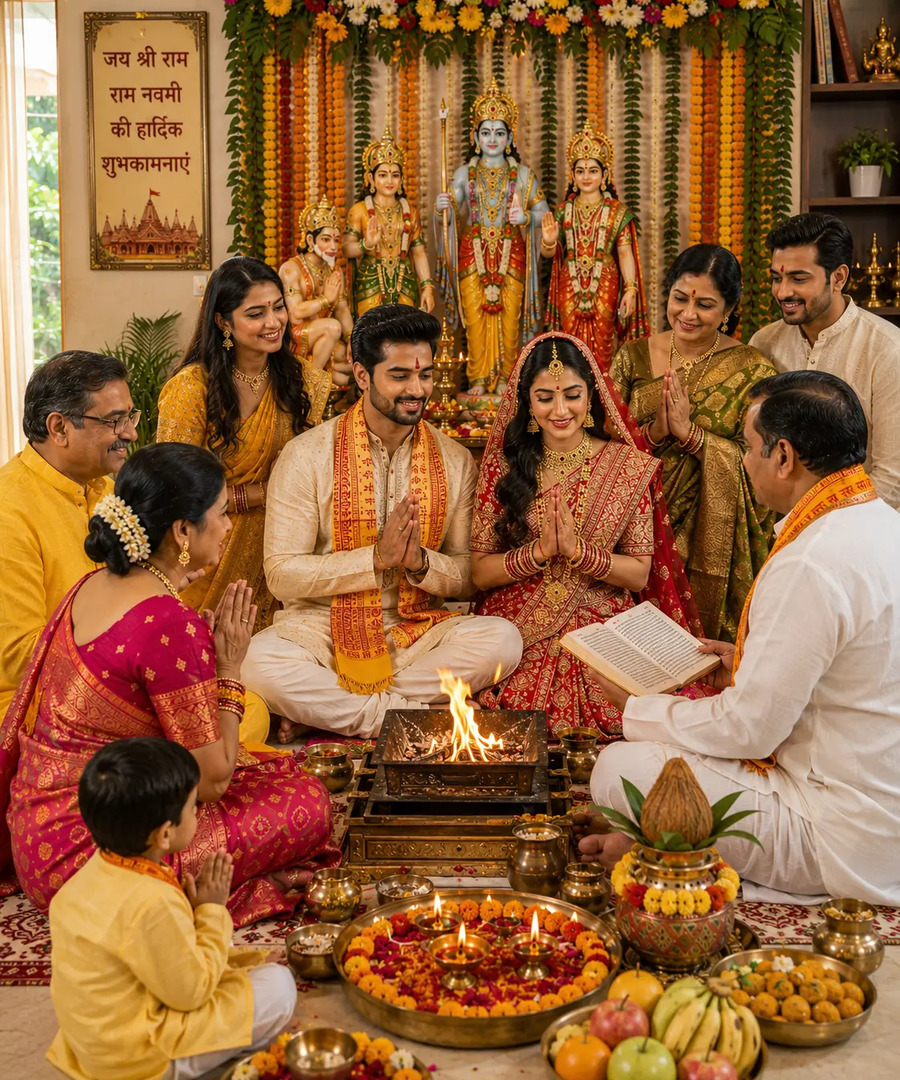
Ram Navami Puja Vidhi

राम नवमी पूजा विधि

General devotional guidance, not a substitute for a priest. Not every step is compulsory; fasting and other practices vary by family and region.

  1. 1

    Prepare yourself and the space

    Bathe, wear clean clothes and tidy the worship area. Place a clean cloth on a raised platform.

  2. 2

    Arrange the image or murti

    Place an image or murti of Shri Rama — or a Ram Darbar with Sita, Lakshmana and Hanuman — respectfully. Some families also place a small cradle for Bal Rama.

  3. 3

    Begin with prayer and intention

    Sit quietly, remember Lord Ganesha as your tradition does, and form a simple intention (sankalp) for devotion, guided by your priest where possible.

  4. 4

    Light a diya safely

    Light a ghee or oil diya on a stable, non-flammable plate, away from curtains, flowers and children’s reach.

  5. 5

    Offer flowers, roli and akshat

    Offer flowers, roli or kumkum, and akshat where your family uses it, along with incense if you wish.

  6. 6

    Offer suitable prasad

    Offer fruit, panakam, kosambari, panjiri or sweets according to regional custom. Share prasad afterwards.

  7. 7

    Read or listen to the Ramayana

    Read or listen to passages from the Valmiki Ramayana or Ramcharitmanas — for example the Bal Kand describing Rama’s birth — using a trusted edition.

  8. 8

    Midday worship and devotional singing

    Many households and temples hold the main worship during the verified Madhyahna period, singing bhajans and kirtans in Rama’s name.

  9. 9

    Perform aarti

    Perform aarti with the diya, then offer a closing prayer of gratitude. Use only aartis and prayers from your tradition or a priest.

  10. 10

    Fasting and conclusion

    Some devotees fast fully, partially or not at all; practices vary by family and region and none are compulsory. Break any fast as your tradition advises.

Ram Navami Puja Samagri

पूजा सामग्री

Requirements vary by tradition. Select only what your family’s worship uses.

0 of 16 items prepared16 में से 0 सामग्री तैयार

Items depend on family, region and the chosen puja; optional items are not universal requirements. · सामग्री परिवार, क्षेत्र और चुनी हुई पूजा अनुसार बदलती है।

Spiritual Significance of Ram Navami

आध्यात्मिक महत्व

Devotion to Shri Rama

Ram Navami invites devotees to remember Rama with love — through his name, his story and simple worship — as many saints of the Bhakti tradition taught.

Dharma and truthfulness

Rama accepted exile to keep his father’s word. The festival encourages reflection on honesty and keeping one’s commitments.

Compassion and responsibility

Rama’s friendship with Guha, Shabari, Sugriva and Vibhishana is remembered as acceptance and care across boundaries; his rule is remembered as responsibility to all.

Courage with restraint

Courage in the Ramayana is joined to humility and self-control — a model for meeting difficulties steadily.

Conclusion of Chaitra Navratri

In many regions Chaitra Shukla Navami is both the ninth day of Chaitra Navratri and Ram Navami, so worship of the Goddess flows into celebration of Rama’s birth. Local tithi timing decides how the two fall.

A spiritual, not material, promise

The festival’s significance is inner: devotion, discipline and right conduct. No particular wealth, health, marriage or other outcome is promised.

12 Rashi Guidance & Puja Impact

बारह राशियों के लिए आध्यात्मिक चिंतन

Optional reflections inspired by traditional zodiac symbolism, not predictions or mandatory Rashi rituals. No wealth, health, marriage, career or future result is promised.

Mesh (Aries)

Devotional guidance
Offer flowers to Rama with a short prayer for patience in leadership.
Reflection
Remember how Rama paused before acting in anger.
Spiritual significance
Channelling energy into dharma rather than haste.
Practical suggestion
Count to ten before replying in a tense moment today.

Vrishabh (Taurus)

Devotional guidance
Prepare simple prasad at home with care and share it.
Reflection
Reflect on Ayodhya’s abundance under righteous rule.
Spiritual significance
Steadiness in providing for others.
Practical suggestion
Share a fruit or meal with someone in need.

Mithun (Gemini)

Devotional guidance
Read or listen to a passage on Rama’s birth from the Bal Kand.
Reflection
Notice how Rama’s words always matched his actions.
Spiritual significance
Truthful and gentle speech.
Practical suggestion
Keep one promise you have been postponing.

Kark (Cancer)

Devotional guidance
Remember Queen Kaushalya’s love while offering a diya.
Reflection
Reflect on family bonds and caring for elders.
Spiritual significance
Gratitude toward those who raised us.
Practical suggestion
Call or visit a parent or elder today.

Singh (Leo)

Devotional guidance
Join the midday aarti with full attention.
Reflection
Consider Rama’s humility despite royal birth.
Spiritual significance
Leadership as service.
Practical suggestion
Credit someone else’s contribution publicly.

Kanya (Virgo)

Devotional guidance
Arrange the altar neatly and offer tulsi where customary.
Reflection
Reflect on Lakshmana’s attentive service.
Spiritual significance
Devoted, careful effort.
Practical suggestion
Help someone quietly with a practical task.

Tula (Libra)

Devotional guidance
Worship the Ram Darbar, honouring Rama and Sita together.
Reflection
Reflect on Rama’s fairness as a king.
Spiritual significance
Balance and justice in relationships.
Practical suggestion
Listen fully to both sides before deciding.

Vrishchik (Scorpio)

Devotional guidance
Sit in silent japa of Rama’s name for a few minutes.
Reflection
Reflect on Vibhishana’s courage to choose dharma.
Spiritual significance
Inner transformation and honesty.
Practical suggestion
Let go of one old grudge.

Dhanu (Sagittarius)

Devotional guidance
Read a chapter of the Ramcharitmanas or listen to a katha.
Reflection
Reflect on the wisdom of Vasishtha and Vishvamitra.
Spiritual significance
Learning from teachers.
Practical suggestion
Thank a teacher or mentor.

Makar (Capricorn)

Devotional guidance
Offer a diya with a prayer for responsibility.
Reflection
Reflect on Rama fulfilling duty during exile.
Spiritual significance
Perseverance through hardship.
Practical suggestion
Complete one pending responsibility today.

Kumbh (Aquarius)

Devotional guidance
Join community bhajans or a temple seva if you can.
Reflection
Reflect on Rama’s friendship with Shabari and Guha.
Spiritual significance
Inclusion and community.
Practical suggestion
Volunteer or donate to a community cause.

Meen (Pisces)

Devotional guidance
Sing or listen to Rama bhajans with devotion.
Reflection
Reflect on Hanuman’s surrender and faith.
Spiritual significance
Bhakti and compassion.
Practical suggestion
Spend a few minutes in quiet gratitude before sleep.

Ram Navami Precautions & Practical Tips

सावधानियाँ

Safe diya use

Keep diyas on stable metal or clay plates, away from fabric, paper and children; never leave a flame unattended.

Responsible temple visits

Expect crowds. Follow temple and police instructions, keep valuables secure, and keep children and elders close.

Respectful participation in processions

Walk only on permitted routes, follow organisers and authorities, avoid pushing, and respect neighbours and other communities.

Hydration and heat

Ram Navami falls in spring heat. Drink water, use shade and head cover, and avoid long midday exposure.

Safe fasting

Fasting is optional and should suit your health and tradition. Children, elders, pregnant people and anyone with medical conditions should consult a doctor; break the fast if unwell.

Food and prasad hygiene

Prepare and store prasad cleanly, especially in warm weather.

Frequently Asked Questions About Ram Navami

Related Festivals

Sources & Tradition Notes

Sacred narrative: Valmiki Ramayana (Bal Kanda) and Goswami Tulsidas’s Ramcharitmanas. References explain traditions, not a verified annual local date. Regional customs vary.

Celebrate Ram Navami with devotion