Nine forms of Shakti · Spring devotion

Chaitra Navratri

चैत्र नवरात्रि

Honour Goddess Durga and her nine forms — the Navdurga — through nine nights of prayer, discipline and renewal in the month of Chaitra, culminating for many families in Rama Navami. Customs vary by region and family.

Navratri begins · Upcoming date not verified · New Delhi, India

Book Pandit Ji
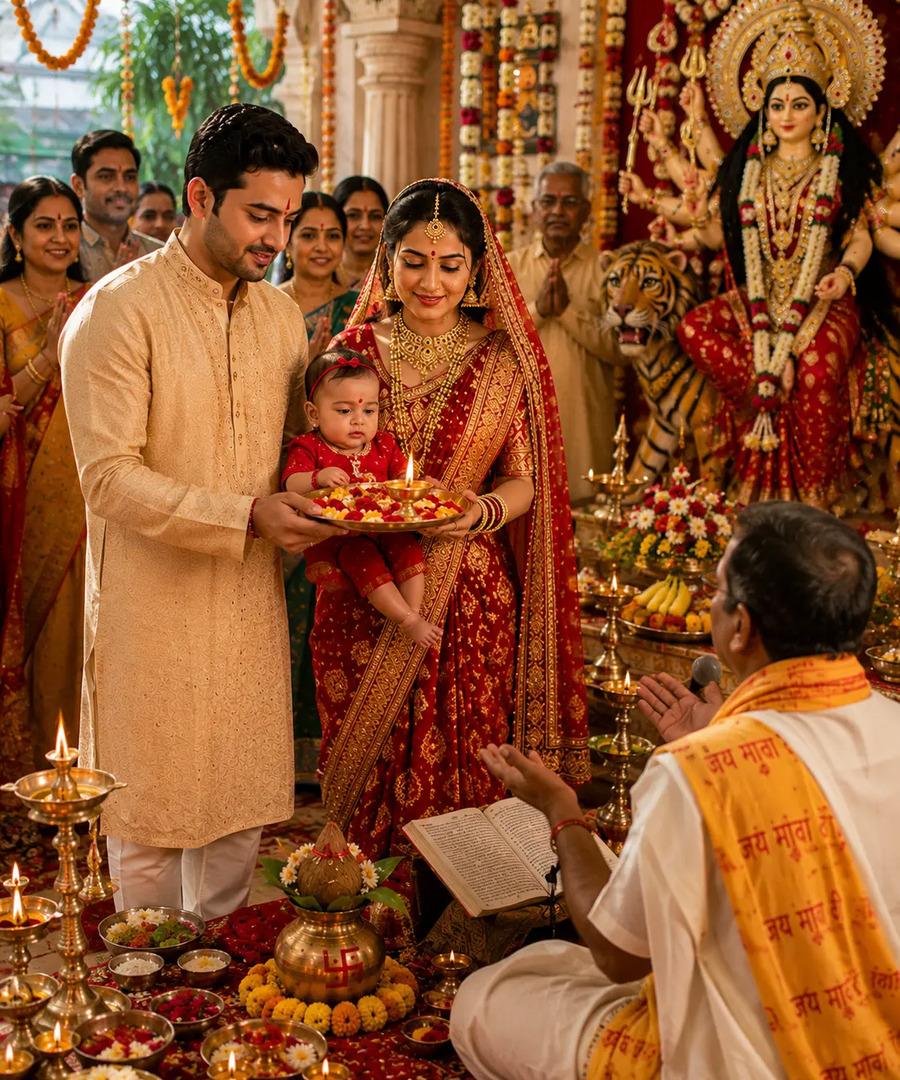
Existing image of an adorned Goddess Durga murti seated on a tiger with marigold garlands

01 / 05

Goddess Durga

माँ दुर्गा

Story & History of Chaitra Navratri

Nine nights of the Goddess in spring

Chaitra Navratri is observed in the bright half (Shukla Paksha) of the lunar month of Chaitra, usually in March or April. Devotees honour Goddess Durga as Shakti, the divine power worshipped in many Hindu traditions as the protective and nurturing Mother. It is often called Vasanta Navratri because it falls in spring, while Sharad Navratri is observed in the autumn month of Ashvin.

Goddess Durga and the Devi Mahatmya

The Devi Mahatmya, part of the Markandeya Purana, narrates the Goddess overcoming forces such as Mahishasura, Madhu-Kaitabha and Shumbha-Nishumbha. Many households recite it, in full or part, during Navratri. Families also use other hymns or simple prayers; recitation is a choice guided by tradition and a priest, not a requirement for every devotee.

The Navdurga tradition

A widely followed sequence worships nine forms of Durga, one on each day: Shailputri, Brahmacharini, Chandraghanta, Kushmanda, Skandamata, Katyayani, Kalaratri, Mahagauri and Siddhidatri. The sequence is commonly associated with the Devi Kavacham tradition. Because tithis can overlap or be skipped, a Navratri may span eight or ten calendar days, and the form honoured on a given date follows the local Panchang.

A new year in several regional calendars

Chaitra Shukla Pratipada begins the lunisolar year in many regions that follow the amanta calendar. It is celebrated as Gudi Padwa in Maharashtra and Ugadi in Karnataka, Andhra Pradesh and Telangana, and the Vikram Samvat year commonly turns in north India on this day. Customs, names and dates differ by community; not every region marks the new year here.

Connection with Rama Navami

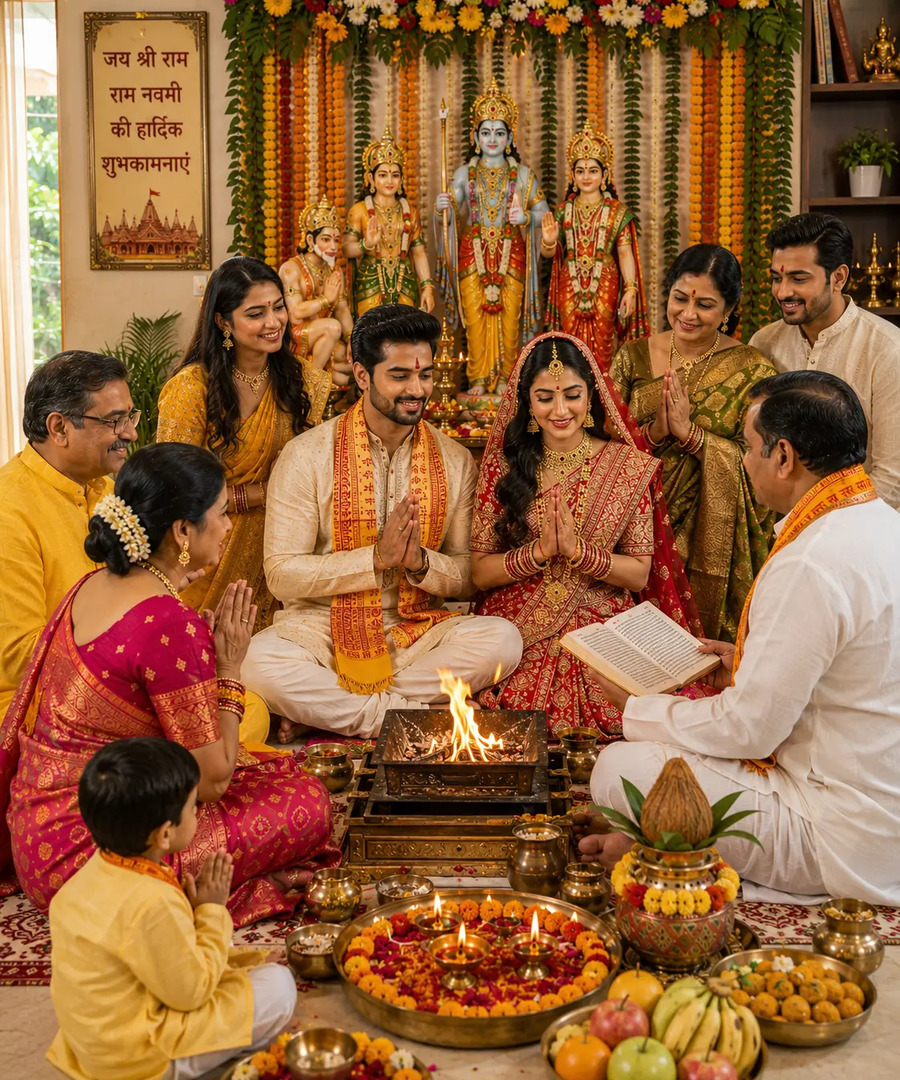
The ninth lunar day, Chaitra Shukla Navami, is celebrated as Rama Navami, the birth of Shri Rama as described in the Ramayana traditions. Many families conclude Chaitra Navratri with Rama Navami worship, Ramayana reading and prasad. In some regions the festival is also observed as Ram Navratri, with daily Ramayana recitation alongside Devi worship.

Regional practice

In north India Ghatasthapana and sown barley (jau or jaware) are widespread; in parts of Rajasthan and Gujarat, the festival may include Gangaur or Devi temple fairs; in Jammu and Himachal Pradesh, pilgrims visit Vaishno Devi and other Shakti shrines. Practices are diverse, and this page describes common customs rather than a single universal rule.

Chaitra Navratri Date, Tithi & Muhurat

New Delhi, India · Asia/Kolkata

Upcoming date not verified

Navratri begins (Chaitra Shukla Pratipada)
Upcoming date not verified
Recorded Tithi
Not verified
Pratipada begins
Not verified
Pratipada ends
Not verified
Ghatasthapana Muhurat
Not verified
Abhijit Muhurat (alternative, where followed)
Not verified
Durga Ashtami
Not verified
Navami
Not verified
Rama Navami
Not verified — see the separate Rama Navami page
Observance concludes
Not verified

No verified upcoming occurrence is available. Automatic Panchang synchronization is not connected; consult your local Panchang.

New Delhi is the configured reference, not your detected location. Each timing appears only when a verified record labels it explicitly; nothing is calculated from sunrise here, and Rama Navami is read as its own verified record, never by adding days. The shared current-year-plus-nine window rolls automatically, but verified Panchang coverage and automatic synchronization are not connected.
Chaitra Navratri: Nine Days of Worship

Commonly followed Navdurga sequence. Tithis can overlap or be skipped, so the form honoured on a calendar date follows your local Panchang.

  1. Day 1 · Pratipada

    Maa Shailputri

    Date: Not verified

    Daughter of the mountain; a steady beginning rooted in devotion.

    Puja guidance: Ghatasthapana where practised, followed by a simple prayer and lamp.

  2. Day 2 · Dwitiya

    Maa Brahmacharini

    Date: Not verified

    The ascetic form; perseverance and inner discipline.

    Puja guidance: Quiet japa or reading; keep offerings simple and sincere.

  3. Day 3 · Tritiya

    Maa Chandraghanta

    Date: Not verified

    The crescent-bell form; courage with calm.

    Puja guidance: Evening aarti with family; refresh flowers at the Kalash.

  4. Day 4 · Chaturthi

    Maa Kushmanda

    Date: Not verified

    Traditionally linked with the creation of the cosmos; warmth and vitality.

    Puja guidance: Offer fruit or a simple satvik prasad according to family custom.

  5. Day 5 · Panchami

    Maa Skandamata

    Date: Not verified

    Mother of Skanda (Kartikeya); compassion and protective care.

    Puja guidance: Pray for family well-being; share prasad with elders and children.

  6. Day 6 · Shashthi

    Maa Katyayani

    Date: Not verified

    The warrior form born to the sage Katyayana; righteous strength.

    Puja guidance: Read a passage from the Devi Mahatmya or recite a familiar hymn.

  7. Day 7 · Saptami

    Maa Kalaratri

    Date: Not verified

    The fierce form that removes fear and darkness.

    Puja guidance: Light a lamp mindfully and reflect on letting go of fear.

  8. Day 8 · Ashtami

    Maa Mahagauri

    Date: Not verified

    The radiant form; purity and peace. Durga Ashtami is observed by many families.

    Puja guidance: Ashtami worship, Kanya Puja or havan where it is the family tradition.

  9. Day 9 · Navami

    Maa Siddhidatri

    Date: Not verified

    Bestower of spiritual accomplishment; completion of the nine days.

    Puja guidance: Navami worship, Rama Navami celebration and respectful conclusion of the Kalash where practised.

Chaitra Navratri Puja Vidhi

चैत्र नवरात्रि पूजा विधि

General devotional guidance, not a substitute for a priest. Not every step is compulsory; Kanya Puja and havan are family or regional traditions.

  1. 1

    Prepare the space

    Clean the home shrine area, arrange a raised platform with a clean cloth, and keep an image or murti of Goddess Durga. Bathe and wear clean clothes before worship.

  2. 2

    Take a sankalpa

    Many devotees state a simple intention for the nine days. If you are unsure of the formal wording, a sincere prayer in your own words is appropriate; a priest can guide a formal sankalpa.

  3. 3

    Ghatasthapana within the verified Muhurat

    On Pratipada, families who practise it sow barley in clean soil and establish a Kalash with water, mango leaves and a coconut. Perform it within the Ghatasthapana Muhurat confirmed for your location; avoid choosing a time without a reliable Panchang.

  4. 4

    Worship the Goddess

    Offer kumkum, akshat, flowers and incense to Goddess Durga, and light a diya. Some families keep an akhand jyoti (continuous lamp) only where it can be supervised safely.

  5. 5

    Daily prayer for the day’s form

    Each day, honour the traditionally associated Navdurga form with a prayer, hymn or reading. Use mantras only from your family tradition or as taught by a priest.

  6. 6

    Offerings and aarti

    Offer fruit, flowers and simple prasad, then perform aarti morning and/or evening. Water the barley gently if sown.

  7. 7

    Ashtami and Navami observances

    Where practised, Ashtami or Navami may include special worship, Kanya Puja honouring young girls with respect and consent of their families, or a havan led by a qualified priest.

  8. 8

    Rama Navami and conclusion

    On Navami many families celebrate Rama Navami with prayer and Ramayana reading. The Kalash and sprouted barley are concluded respectfully according to family custom, often on Navami or Dashami.

Chaitra Navratri Puja Samagri

पूजा सामग्री

Requirements vary by tradition. Select only what your family’s worship uses.

0 of 16 items prepared16 में से 0 सामग्री तैयार

Items depend on family, region and the chosen puja; optional items are not universal requirements. · सामग्री परिवार, क्षेत्र और चुनी हुई पूजा अनुसार बदलती है।

Spiritual Significance of Chaitra Navratri

आध्यात्मिक महत्व

Devotion to Shakti

Navratri honours the Goddess as the energy that sustains life. Worship is an expression of reverence, gratitude and surrender, offered in whatever form suits the devotee.

Discipline and renewal

Fasting, early rising, prayer and simple food are traditional ways to practise self-restraint. Coming at the start of spring and, for many, the new year, the nine days invite renewal of intentions.

Nine forms, nine reflections

Each Navdurga form offers a theme for reflection — steadiness, perseverance, courage, vitality, compassion, strength, fearlessness, purity and fulfilment.

Rama Navami and regional new years

The festival’s ninth day honours Shri Rama’s birth, joining Shakti worship with Rama bhakti. Its first day coincides with Gudi Padwa, Ugadi and the Vikram Samvat new year in several regions.

No promised outcomes

Traditions describe spiritual and personal benefits of prayer and reflection. This page does not promise material, health or spiritual results from any ritual.

12 Rashi Guidance & Puja Impact

बारह राशियों के लिए आध्यात्मिक चिंतन

Optional reflections inspired by traditional zodiac symbolism, not predictions or mandatory Rashi rituals. No wealth, health, marriage, career or future result is promised.

Mesh (Aries)

Devotional guidance
Begin the new year with a calm, focused prayer to Maa Shailputri.
Reflection
Reflect on where enthusiasm could become steady commitment.
Spiritual significance
Shailputri’s mountain steadiness balances quick beginnings.
Practical suggestion
Choose one small daily habit and keep it for all nine days.

Vrishabh (Taurus)

Devotional guidance
Offer fresh flowers with gratitude for simple comforts.
Reflection
Notice attachment to routine and invite gentle change.
Spiritual significance
Spring renewal reminds us that growth needs openness.
Practical suggestion
Share fruit or prasad with a neighbour.

Mithun (Gemini)

Devotional guidance
Read a short passage from a Devi hymn each evening.
Reflection
Practise mindful speech; pause before replying.
Spiritual significance
Brahmacharini’s discipline steadies a busy mind.
Practical suggestion
Keep a short daily note of one thing learnt.

Kark (Cancer)

Devotional guidance
Pray to Maa Skandamata for the care of your family.
Reflection
Reflect on how you nurture yourself as well as others.
Spiritual significance
The Mother’s compassion includes self-compassion.
Practical suggestion
Call or visit an elder relative during the nine days.

Singh (Leo)

Devotional guidance
Light the evening diya with a prayer for humility.
Reflection
Consider how confidence can serve others.
Spiritual significance
Chandraghanta’s courage is calm, not proud.
Practical suggestion
Help prepare the puja space for the whole household.

Kanya (Virgo)

Devotional guidance
Arrange the samagri mindfully, as an act of devotion.
Reflection
Let go of perfectionism; sincerity matters more.
Spiritual significance
Mahagauri’s purity is about the heart, not flawlessness.
Practical suggestion
Prepare simple, hygienic prasad with care.

Tula (Libra)

Devotional guidance
Pray for harmony in relationships.
Reflection
Reflect on fairness and kindness in a recent decision.
Spiritual significance
Navratri’s balance of strength and grace mirrors inner equilibrium.
Practical suggestion
Resolve one small misunderstanding with kindness.

Vrishchik (Scorpio)

Devotional guidance
Seek Maa Kalaratri’s blessing to release fear.
Reflection
Write down a worry and reflect on what is within your control.
Spiritual significance
Kalaratri represents fearlessness and transformation.
Practical suggestion
Spend a few minutes in quiet breathing before aarti.

Dhanu (Sagittarius)

Devotional guidance
Read the Rama Navami story with family.
Reflection
Reflect on dharma as everyday right action.
Spiritual significance
Shri Rama’s life links Navratri devotion to ethical living.
Practical suggestion
Offer time or help to a local cause.

Makar (Capricorn)

Devotional guidance
Keep a steady daily prayer, however short.
Reflection
Reflect on patience with long-term efforts.
Spiritual significance
Katyayani’s strength is disciplined and purposeful.
Practical suggestion
Plan rest alongside work during the festival.

Kumbh (Aquarius)

Devotional guidance
Join a community aarti or temple visit where comfortable.
Reflection
Consider how your ideas can serve the wider community.
Spiritual significance
Shakti is experienced in collective devotion as well as private prayer.
Practical suggestion
Share festival preparation tasks with others.

Meen (Pisces)

Devotional guidance
Offer a quiet prayer to Maa Siddhidatri at the close of the nine days.
Reflection
Reflect on gratitude for the season’s experiences.
Spiritual significance
Siddhidatri signifies completion and inner fulfilment.
Practical suggestion
Write a short gratitude list on Navami.

Chaitra Navratri Precautions & Practical Tips

सावधानियाँ

Safe diya and akhand jyoti use

Place lamps on a stable, non-flammable surface away from curtains, cloth and flowers. Never leave a lamp unattended where children or pets can reach it; keep water or a fire extinguisher nearby.

Responsible prasad preparation

Wash hands and utensils, use fresh ingredients, store cooked prasad safely and avoid leaving it in heat for long. Label common allergens when sharing.

Safe fasting

Fasting is optional. Pregnant or breastfeeding people, children, older adults and anyone with diabetes, low blood pressure or other conditions should consult a doctor; partial fasts or simple satvik meals are equally devotional.

Hydration

Spring weather can be warm. Drink water regularly unless a doctor advises otherwise, and stop fasting if you feel dizzy or unwell.

Adapt to your circumstances

Rituals, restrictions and food rules differ by family and region. Adapt the worship to your health, home and schedule; a simple sincere prayer is a valid observance.

Respectful Kanya Puja

Invite children only with their parents’ consent, keep the gathering comfortable and hygienic, and offer food suitable for children.

Frequently Asked Questions About Chaitra Navratri

Related Festivals

Sources & Tradition Notes

Sacred narrative: Devi Mahatmya (Markandeya Purana); Rama Navami in the Ramayana traditions. References explain traditions, not a verified annual local date. Regional customs vary.

Celebrate Chaitra Navratri with devotion