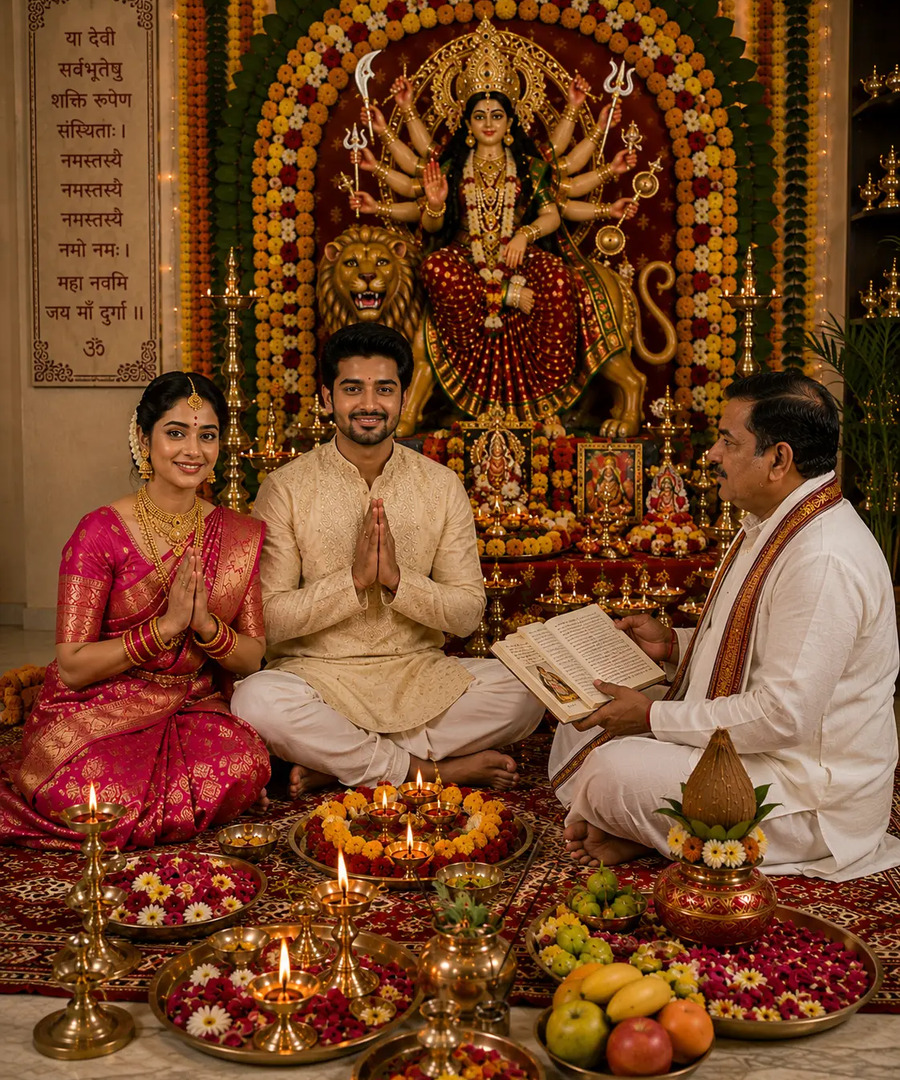
Religious narrative and documented history
The accounts below come from the Devi Mahatmya and living tradition. They are devotional narratives, not documented historical events, and retellings vary.
Ashwin Shukla Ashtami · Maa Mahagauri · Sandhi Puja · Kanya Pujan
Durga Ashtami — दुर्गा अष्टमी — falls on the eighth lunar day (Ashtami) of the bright fortnight of Ashwin during Sharad Navratri. In the commonly followed Navadurga sequence it is the day of Maa Mahagauri. Many North Indian families observe Kanya Pujan, while in Bengali Durga Puja it is Maha Ashtami, marked by Sandhi Puja. Customs and calendar conventions differ by region.
Next Durga Ashtami · Panchang data unavailable—please verify with your local Panchang. · New Delhi, India
01 / 05
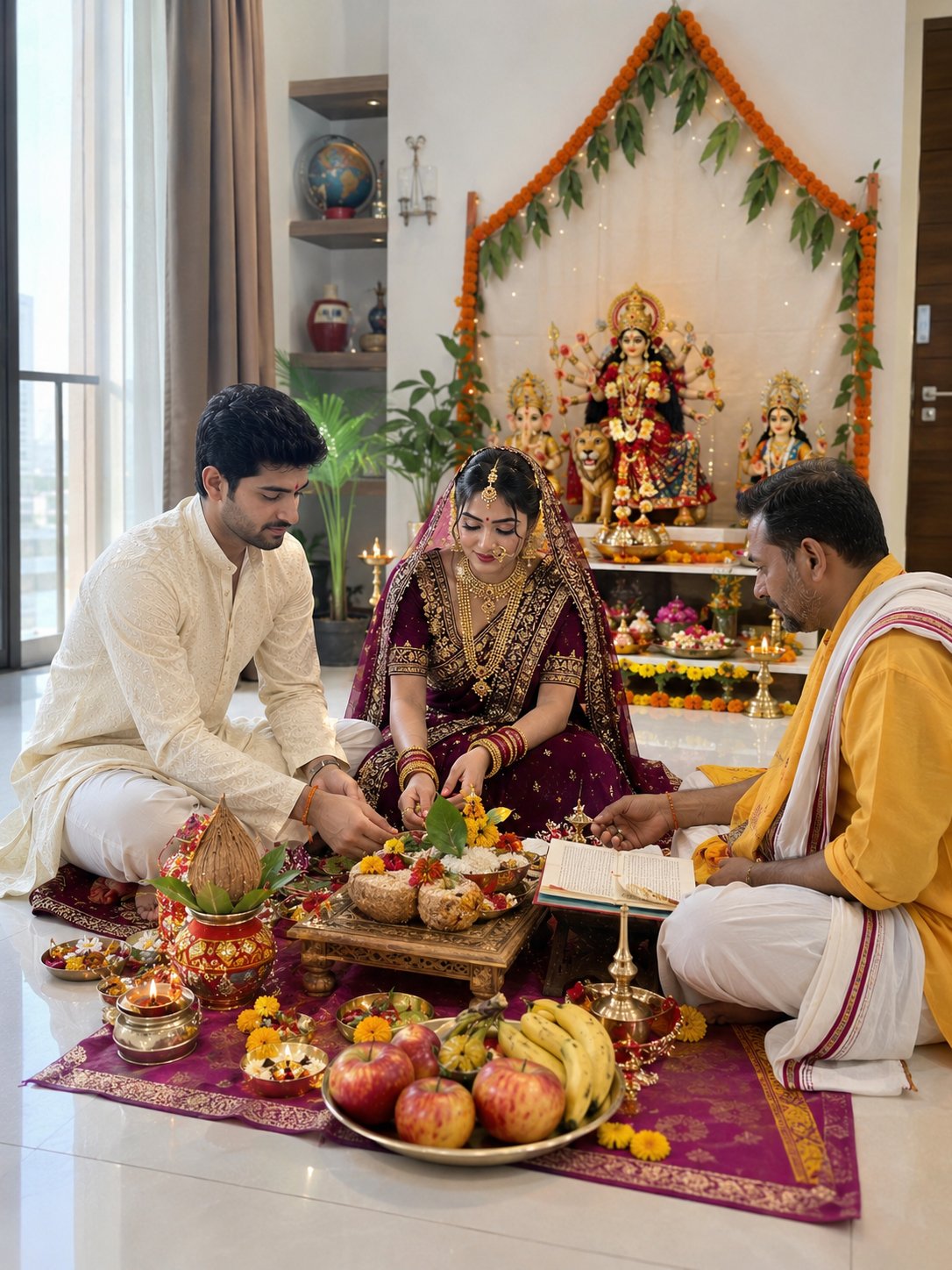
Ashtami puja for Maa Durga
दुर्गा अष्टमी पूजा
Customs differ by region and family. Kanya Pujan may be on Ashtami or Navami, Sandhi Puja is not observed everywhere, and fasting is optional.
Panchang · New Delhi, India · Asia/Kolkata
Panchang data unavailable—please verify with your local Panchang.
Panchang data unavailable—please verify with your local Panchang. No verified upcoming occurrence is available. Automatic Panchang synchronization is not connected; consult your local Panchang.
Dates come from the shared verified calendar for the rolling current year plus nine years; only Ashwin Shukla records are accepted. Sandhi Puja is shown only when its verified window contains the recorded Ashtami end time — never a fixed clock time or another city’s timing. No licensed Panchang provider is connected, so missing values are never estimated. New Delhi is the reference location; city selection is not available yet.
दुर्गा अष्टमी पूजा विधि
Common practices are listed; regional customs differ. No mantras or compulsory steps are prescribed — follow your family or priest.
Clean the puja area and arrange a chowki with a clean cloth.
Place Maa Durga’s image or murti respectfully.
Offer flowers, kumkum, akshat, a diya, incense and suitable bhog.
Honour Maa Mahagauri as the eighth form in the commonly followed Navadurga tradition; regional customs differ.
Recite or listen to the Durga Ashtami katha or a text your household follows, such as Durga Saptashati or Durga Chalisa.
Perform aarti and offer prasad.
Traditions that observe Sandhi Puja perform it at the Ashtami–Navami junction, using only the timing from your local Panchang.
Honour young girls as forms of the Goddess, with parental consent, offering food and small gifts.
Households that complete the vrat on Ashtami do so after puja and Kanya Pujan; others continue to Navami. Follow your family custom.
Prepare for Navami worship, Siddhidatri puja in the Navadurga sequence, and in some homes Havan or Kanya Pujan on Navami.
पूजा सामग्री सूची
Tick items as you prepare; progress is saved on this device. Optional and regional items are marked — none is compulsory for every household.
0 of 12 items prepared12 में से 0 सामग्री तैयार
Items depend on family, region and the chosen puja; optional items are not universal requirements. · सामग्री परिवार, क्षेत्र और चुनी हुई पूजा अनुसार बदलती है।
संधि पूजा
Sandhi Puja is traditionally performed in the period spanning the last part of Ashtami and the first part of Navami. Many Panchangs describe it as the final 24 minutes of Ashtami and the first 24 minutes of Navami; the actual clock time depends on the local tithi transition.
In relevant traditions it honours the Goddess as Chamunda, who defeated Chanda and Munda.
The tithi transition changes by location and year. Never copy another city’s timing. This page shows Sandhi Puja only from a verified record that contains the Ashtami end time.
In many Bengali traditions, 108 lamps and 108 lotuses are offered. Households may offer far fewer; follow your tradition.
Sandhi Puja is especially important in Bengali Durga Puja and is not performed in every household.
If lighting many lamps, place them on a metal tray on a stable surface, away from cloth and decorations, keep water or an extinguisher nearby and assign someone to watch them.
कन्या पूजन / कुमारी पूजा
Kanya Pujan — Kanjak in many North Indian homes, Kumari Puja in Bengal and elsewhere — honours young girls as embodiments of the Goddess’s feminine power.
Families perform it on Ashtami or Navami according to custom.
Halwa, puri and black chana are customary in many North Indian homes, along with fruits and small gifts.
The number of children invited (often nine, sometimes with one boy as Langur/Bhairav) and the procedure vary by family and region.
Participation must be voluntary with parents’ consent. Respect allergies and food safety, never pressure a child, keep the event comfortable and supervised.
Families who do not perform Kanya Pujan, or follow a different custom, are not spiritually lesser.
व्रत, भोग और प्रसाद
Some fast the full day, some eat once, some follow fruit or non-grain meals, and many do not fast. All are acceptable.
Halwa, puri and chana in North India; bhog such as khichuri and labra in many Bengali pandals. Offerings vary by region.
In households that end the Navratri vrat on Ashtami, it is completed after puja and Kanya Pujan.
Prayer, reading, charity and kindness are sincere observances.
Strict or waterless fasting is not compulsory. Pregnant people, children, older adults and people with medical conditions or medication schedules affected by food or fluids should prioritise health and seek medical advice.
आध्यात्मिक महत्व
The Goddess embodies both fierce protection and motherly compassion.
Ashtami’s worship invites steady practice and sincere devotion.
The victories in the Devi Mahatmya symbolise the overcoming of negativity, within and around us.
Helping others, respecting women and children, and cultivating inner strength carry the meaning into daily life.
These are devotional meanings; the puja does not guarantee wealth, health, marriage, career success or supernatural outcomes.
क्षेत्रीय परंपराएँ
Household Durga Ashtami puja, Mahagauri worship and Kanya Pujan in many homes; some families hold Kanya Pujan on Navami.
Maha Ashtami of Durga Puja, with Pushpanjali, Sandhi Puja and in some places Kumari Puja.
Kumari Puja, offerings, fasting and the order of worship differ between regions and families.
Durga Ashtami belongs to the wider Navratri / Durga Puja festival; customs and dates can vary, and no single practice is the only correct one.
मार्गदर्शन
Check your city’s Panchang; Ashtami may span two civil days and the observance day depends on the convention used.
Use a local Panchang calculated for your location — never a timing from another city.
Ask elders which day your family follows.
Keep lamps on non-flammable bases and food covered.
Choose a practice that suits your health.
Follow queues and organisers’ instructions, keep children close and respect others’ customs.
When family ritual rules are unclear, a knowledgeable priest can guide you.
बारह राशि मार्गदर्शन
Traditional spiritual reflection, not scientific prediction. No health, wealth, marriage or career outcome is promised, and no Rashi is unlucky or inferior.
क्या करें, क्या न करें
Use stable, non-flammable bases and never leave flames unattended.
Keep lamps clear of curtains, garlands and combustible decorations.
Cook cleanly, keep food covered, distribute promptly and respect allergies.
Only with parental consent; never coerce a child.
At pandals, know the exits, stay hydrated and keep children close.
Compost flowers and avoid plastic decorations.
Regional customs vary; nobody should be shamed for not fasting.
Avoid warnings about curses or punishment for missed rituals.
Narratives are traditional and vary by text and region. No dates, mantras, scriptural quotations or timings have been invented on this page.