Vaishakha Purnima · Vesak · Buddha Jayanti

Buddha Purnima – बुद्ध पूर्णिमा

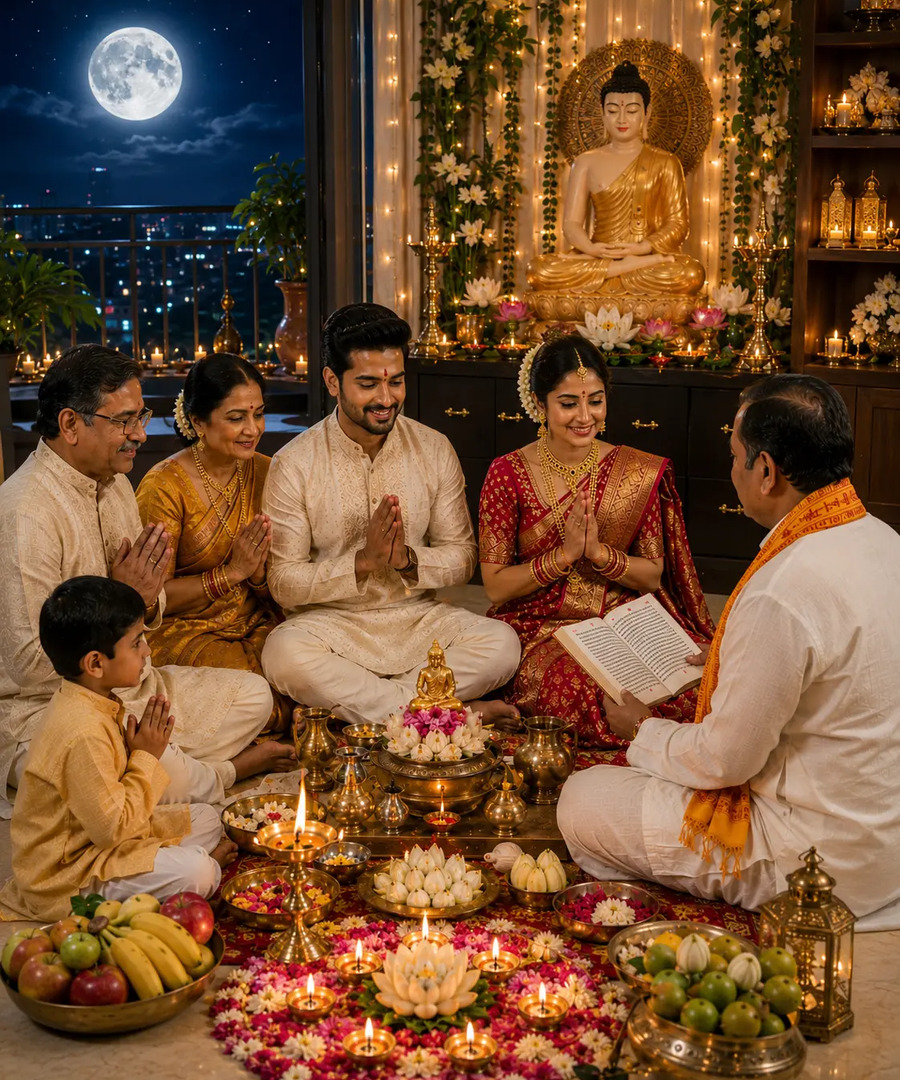
Honour Gautama Buddha and his teachings of compassion, mindfulness, wisdom and non-violence — a path described in Buddhist tradition as leading towards liberation from suffering. Known as Vesak or Buddha Jayanti in various traditions, the full moon is marked with meditation, reflection, generosity and service. Customs and calendars differ across Buddhist communities.

Buddha Purnima · Upcoming date not verified · Tithi not verified · New Delhi, India

View Date & Tithi

Image placeholder — to be replaced

A traditional depiction of Gautama Buddha in peaceful meditation — approved image awaiting upload

01 / 05

Gautama Buddha in meditation

ध्यानमग्न भगवान बुद्ध

Buddha Purnima: Story & History

A note on tradition and history

Most historians accept that Siddhartha Gautama was a real teacher who lived in northern India and present-day Nepal, commonly dated to roughly the 5th–6th century BCE, though exact dates are debated. Many details of his life come from later Buddhist texts and are cherished as traditional accounts rather than independently verified history.

Birth and early life

Buddhist tradition recounts that Siddhartha was born a prince of the Shakya clan at Lumbini and raised in comfort at Kapilavastu, shielded from the hardships of the world.

Encountering suffering

According to tradition, on journeys beyond the palace he saw an old person, a sick person, a corpse and a wandering renunciant. These “Four Sights” moved him to seek an understanding of why suffering exists and whether it can end.

The great renunciation

Tradition relates that he left his princely life to search for truth, studying with teachers and practising severe austerities. Finding that extreme self-denial did not bring understanding, he chose a balanced “Middle Way” between indulgence and harsh asceticism.

Enlightenment under the Bodhi tree

Buddhist tradition holds that at Bodh Gaya he sat in meditation beneath a pipal tree, later called the Bodhi tree, and attained awakening (bodhi). From then he was known as the Buddha, “the awakened one.”

Teaching the path

He gave his first teaching at Sarnath near Varanasi, describing the Four Noble Truths and the Noble Eightfold Path. For the rest of his life he taught compassion, mindfulness, ethical conduct and wisdom to people of every background.

Parinirvana

Tradition records that the Buddha passed away at Kushinagar around the age of eighty, entering parinirvana — final release from the cycle of rebirth.

Vesak: birth, enlightenment and passing

In many Theravada traditions and in the United Nations recognition of the Day of Vesak, the full moon of Vesak commemorates the Buddha’s birth, enlightenment and parinirvana together. Some East Asian traditions mark these events on separate days.

Why the day is observed

Buddhist communities, and many others who honour the Buddha’s teachings, use the day to remember his life, renew ethical commitments, meditate and practise generosity. In India it is widely known as Buddha Purnima or Buddha Jayanti.

Observances across cultures

Customs differ widely: temple visits, offerings of flowers and light, sermons, meditation, observing precepts, lantern displays in Sri Lanka, bathing the infant Buddha in East Asian traditions, and food donation and community service. No single ritual applies to every Buddhist community.

Buddha Purnima Date, Tithi & Observance Timings

New Delhi, India · Asia/Kolkata

Upcoming date not verified

Buddha Purnima (Vaishakha Purnima, Indian Panchang)
Upcoming date not verified
Recorded Tithi
Not verified
Purnima Tithi begins
Not verified
Purnima Tithi ends
Not verified
Sunrise
Not verified
Moonrise
Not verified
Observance notes
Not verified

No verified upcoming occurrence is available. Automatic Panchang synchronization is not connected; consult your local Panchang.

New Delhi is the configured reference location; city selection is not yet available. The date above follows the Indian Hindu Panchang rule for Vaishakha Purnima (the full-moon tithi prevailing at local sunrise) and applies only to the listed city. Buddhist communities in Sri Lanka, Thailand, Myanmar, Nepal, East Asia and elsewhere may follow their own lunar or lunisolar calendars, so Vesak can fall on a different day — please confirm with your local temple or vihara. Timings appear only from a verified record; nothing is calculated or guessed. The shared current-year-plus-nine window rolls forward automatically, but verified Panchang coverage is not yet connected.

Buddha Purnima Puja Vidhi & Observances – Step-by-Step

बुद्ध पूर्णिमा पूजा विधि एवं अनुष्ठान

Practical, respectful guidance only. Customs differ across Theravada, Mahayana, Vajrayana and regional traditions; a Hindu-style puja is not required of any Buddhist community, and no step is compulsory. Follow your own community where it has a practice.

  1. 1

    Clean the space

    Clean your home or the chosen place of observance as a quiet act of care.

  2. 2

    Prepare a peaceful space

    If it is your custom, place a Buddha image or another appropriate symbol respectfully, at or above eye level.

  3. 3

    Offer simply

    Offer flowers, clean water or a lamp according to your family or community tradition.

  4. 4

    Meditate or reflect

    Spend time in meditation, mindful breathing or quiet reflection.

  5. 5

    Read or listen to teachings

    Read or listen to teachings attributed to the Buddha from reliable translations or a qualified teacher.

  6. 6

    Reflect on the core teachings

    Contemplate the Four Noble Truths and the Noble Eightfold Path and what they mean in your life.

  7. 7

    Practise loving-kindness

    Cultivate goodwill, compassion and non-violence in thought, speech and action.

  8. 8

    Join a community observance

    Visit a Buddhist temple or vihara, or take part in a community observance, if you wish.

  9. 9

    Give and serve

    Donate food, support people in need or perform an act of service.

  10. 10

    Close with gratitude

    End with gratitude and one practical commitment to ethical living in the days ahead.

Buddha Purnima Observance Checklist

तैयारी सूची

Tick items as you prepare; your progress is saved on this device.

0 of 10 items prepared10 में से 0 सामग्री तैयार

Items depend on family, region and the chosen puja; optional items are not universal requirements. · सामग्री परिवार, क्षेत्र और चुनी हुई पूजा अनुसार बदलती है।

Spiritual Significance of Buddha Purnima

आध्यात्मिक महत्व

Compassion and loving-kindness

Karuna (compassion) is the wish for others to be free from suffering; metta (loving-kindness) is goodwill towards all beings, including people we find difficult.

Mindfulness

Sati, mindfulness, means clear, non-judging awareness of the body, feelings, mind and present experience. It is a practice developed over time, not a quick fix.

Wisdom and understanding

Wisdom (prajna/panna) is seeing clearly how things are — including impermanence and how craving gives rise to suffering.

Non-violence and ethical conduct

Ethical conduct (sila) begins with refraining from harm. Common lay precepts include avoiding killing, stealing, sexual misconduct, false speech and intoxicants that cloud the mind.

The Four Noble Truths

Suffering (dukkha) is part of life; it arises from craving; it can cease; and there is a path leading to its cessation.

The Noble Eightfold Path

Right view, right intention, right speech, right action, right livelihood, right effort, right mindfulness and right concentration — often grouped as wisdom, ethics and meditation.

Generosity, gratitude and service

Dana, generosity, is a foundation of practice. Giving freely, with gratitude, loosens attachment and supports others.

Teachings in everyday life

These ideas can shape how we listen, speak, work and decide. Meditation and reflection support wellbeing for many people, but they do not guarantee particular health, financial or life outcomes.

12 Rashi Guidance & Puja Impact

बारह राशियों के लिए आध्यात्मिक चिंतन

Optional traditional astrological reflection — not a core Buddhist teaching. These are gentle prompts for mindful living, not predictions; no wealth, health, marriage, employment or future result is promised.

Mesh (Aries) · मेष

Reflective guidance
Let quick energy pause before it becomes reaction.
Reflection
Patience: a breath between impulse and action is itself a practice.
Practice for the day
Before replying in any tense moment today, take three slow breaths.
Connection to Buddha Purnima
The Buddha taught the Middle Way, between extremes.

Vrishabh (Taurus) · वृषभ

Reflective guidance
Notice where comfort turns into clinging.
Reflection
Generosity: loosening attachment brings lightness.
Practice for the day
Give away one useful item you no longer need.
Connection to Buddha Purnima
Siddhartha set aside palace comforts to seek understanding.

Mithun (Gemini) · मिथुन

Reflective guidance
Choose words that are true, kind and timely.
Reflection
Right speech: words can heal as easily as they can hurt.
Practice for the day
Spend one hour avoiding gossip and harsh speech.
Connection to Buddha Purnima
Right speech is a step of the Noble Eightfold Path.

Kark (Cancer) · कर्क

Reflective guidance
Extend the care you give family to yourself as well.
Reflection
Compassion: kindness that includes oneself is steadier.
Practice for the day
Practise five minutes of loving-kindness for yourself, then a loved one.
Connection to Buddha Purnima
Metta begins with goodwill and widens to all beings.

Singh (Leo) · सिंह

Reflective guidance
Let confidence serve others rather than seek recognition.
Reflection
Humility: true strength is quiet.
Practice for the day
Help someone today without telling anyone.
Connection to Buddha Purnima
The prince became the Buddha by letting go of status.

Kanya (Virgo) · कन्या

Reflective guidance
Release the urge to make everything perfect.
Reflection
Wisdom: accepting impermanence eases strain.
Practice for the day
Do one task slowly and mindfully, noticing each step.
Connection to Buddha Purnima
Impermanence is central to the Buddha’s teaching.

Tula (Libra) · तुला

Reflective guidance
Seek balance in a relationship that feels uneven.
Reflection
Equanimity: steady goodwill towards everyone alike.
Practice for the day
Listen fully to someone without planning your reply.
Connection to Buddha Purnima
The Middle Way is a path of balance.

Vrishchik (Scorpio) · वृश्चिक

Reflective guidance
Look gently at a resentment you still carry.
Reflection
Non-violence: letting go of ill-will frees the heart.
Practice for the day
Write down one grudge and a wish for that person’s wellbeing.
Connection to Buddha Purnima
The Buddha taught that hatred is not ended by hatred.

Dhanu (Sagittarius) · धनु

Reflective guidance
Turn the search for meaning inward today.
Reflection
Wisdom: understanding grows through reflection, not only seeking.
Practice for the day
Read a short passage from a reliable Buddhist text and reflect on it.
Connection to Buddha Purnima
Siddhartha’s journey ended in stillness beneath the Bodhi tree.

Makar (Capricorn) · मकर

Reflective guidance
Examine whether your work causes harm to anyone.
Reflection
Right livelihood: earning in ways that respect others.
Practice for the day
Identify one small change that makes your work kinder.
Connection to Buddha Purnima
Right livelihood is part of the Eightfold Path.

Kumbh (Aquarius) · कुम्भ

Reflective guidance
Turn ideals for community into one concrete act.
Reflection
Service: compassion is completed in action.
Practice for the day
Volunteer, donate food or support a local cause.
Connection to Buddha Purnima
Buddha Purnima is widely marked through dana and service.

Meen (Pisces) · मीन

Reflective guidance
Rest in quiet awareness rather than daydreaming.
Reflection
Mindfulness: being present with what is.
Practice for the day
Sit for ten minutes following the breath under an open sky or by a window.
Connection to Buddha Purnima
Tradition places the awakening on a full-moon night.

Mindfulness, Charity & Important Considerations

ध्यान, दान और महत्वपूर्ण बातें

Common observances

Meditation, temple visits, listening to teachings, ethical reflection, observing precepts and acts of service are widely practised.

Generosity and helping others

Food donation, supporting the sick or elderly, and caring for animals and the environment are meaningful expressions of the day.

Respect for traditions

Theravada, Mahayana, Vajrayana and other communities have their own customs and calendars. Follow local practice and the guidance of your community.

Fasting is not compulsory

Some lay practitioners observe eight precepts, including not eating after midday, but practices vary and fasting is not required for everyone. Consider your health.

Use reliable teachings

Many quotations online are wrongly attributed to the Buddha. Prefer recognised translations, scholars and teachers.

Everyday practice

Pause before reacting, speak kindly, eat mindfully and offer help — small daily habits carry the spirit of the festival.

Frequently Asked Questions About Buddha Purnima

Related Festivals

Sources & Tradition Notes

Traditional accounts of the Buddha’s life come from Pali and Sanskrit Buddhist texts; versions differ by tradition. No quotations are attributed to the Buddha on this page. References explain traditions, not a verified annual local date.

Observe Buddha Purnima with compassion