Kanya Sankranti · Divine Architect · Tools, Craft & Work

Vishwakarma Puja / विश्वकर्मा पूजा

Vishwakarma Puja honours Lord Vishwakarma, revered in Hindu tradition as the divine architect and craftsman. Artisans, mechanics, engineers, factory and construction workers, technicians and families who depend on tools offer gratitude for their skills, equipment and livelihood. In much of eastern and northern India it is observed on Kanya Sankranti; other communities follow different regional dates.

Next Vishwakarma Puja (Kanya Sankranti tradition) · Panchang data unavailable—please verify with your local Panchang. · New Delhi, India
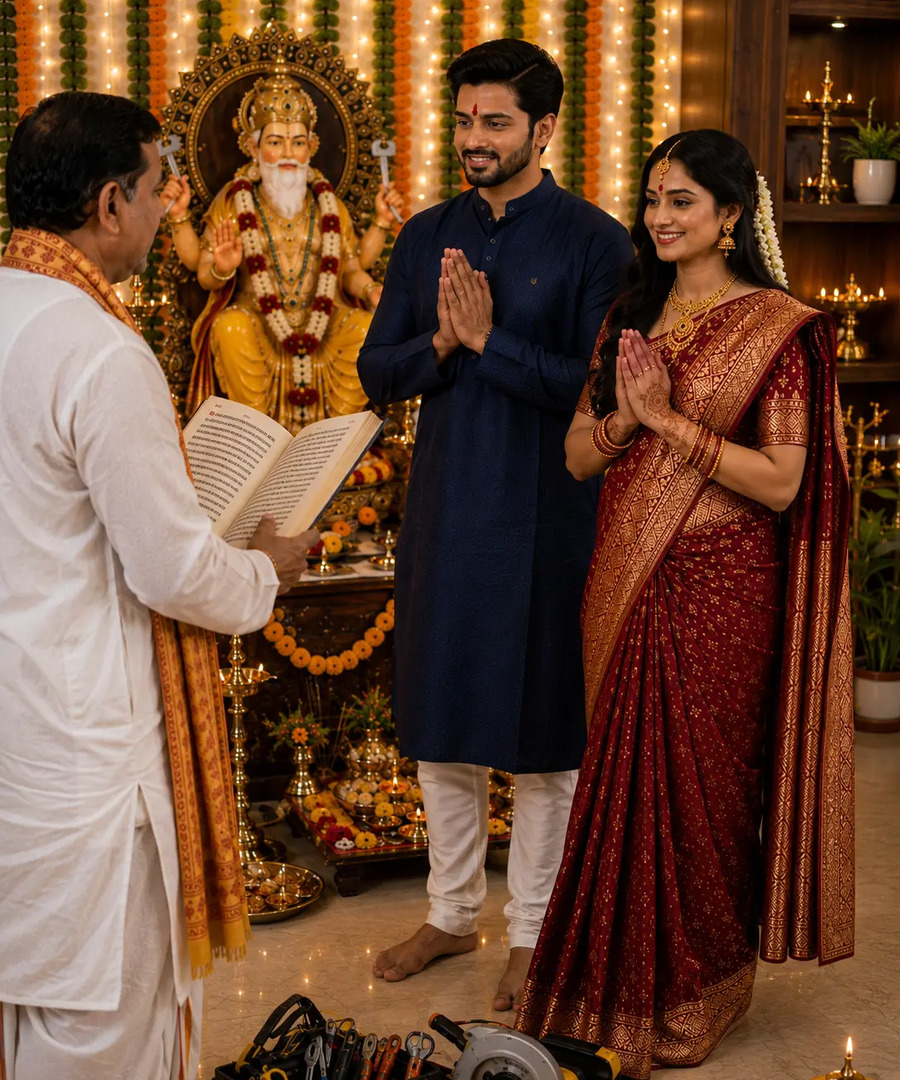
Existing image: a garlanded golden murti of Lord Vishwakarma holding tools, with a priest reading and a couple praying with folded hands, and tools placed safely on the floor

01 / 05

Lord Vishwakarma, the divine architect

भगवान विश्वकर्मा

Safety first. Switch off and isolate all machinery before any puja near it. Rituals never replace inspection, training, protective equipment or legal safety procedures.

Puranik Katha & History

Traditional narrative and documented history

The accounts below come from Hindu religious literature and popular tradition. They are devotional narratives, not documented historical events, and they differ between texts and regions.

The divine architect

Vishwakarma — “maker of all” — appears in the Rigveda as a name for the creator of the universe. In later Puranic and epic tradition he is described as the architect and craftsman of the gods.

Celestial works in tradition

Popular accounts credit him with designing divine cities and palaces — such as Indra’s capital, Dwarka for Krishna, and in some retellings Lanka — and with crafting divine weapons and chariots. Lists and details vary by text and region.

Many forms, many communities

Several artisan communities regard Vishwakarma as their patron and ancestor, and some traditions describe him with five faces associated with different crafts. These beliefs are held differently across India.

Why workers celebrate

For people whose livelihood rests on skill and tools — carpenters, smiths, weavers, mechanics, electricians, engineers, architects, drivers and factory staff — the day is a time to thank the divine for knowledge, safe work and the means to earn. Workplaces are cleaned, tools are honoured and colleagues share prasad.

Regional observance

In West Bengal, Odisha, Bihar, Jharkhand, Assam, Tripura and parts of North India the festival is commonly linked to Kanya Sankranti, the Sun’s entry into Virgo, which usually falls in mid-September. Some communities instead observe Vishwakarma worship the day after Diwali, on Magha Shukla Trayodashi, or on a date fixed by local or workplace custom.

Vishwakarma Puja Date, Kanya Sankranti & Puja Period

Panchang · New Delhi, India · Asia/Kolkata

Panchang data unavailable—please verify with your local Panchang.

Observance shown
Kanya Sankranti tradition (eastern and northern India)
Verified record
Not verified
Kanya Sankranti moment
Not verified
Punya Kaal
Not verified
Puja period
Not verified
Local sunrise
Not verified
Other traditions
Day after Diwali, Magha Shukla Trayodashi or local workplace custom — not shown as this date
Tradition & notes
Not verified

Panchang data unavailable—please verify with your local Panchang. No verified upcoming occurrence is available. Automatic Panchang synchronization is not connected; consult your local Panchang.

The shared verified calendar reads the rolling current year plus nine years. No licensed Panchang provider is connected, so missing dates, the Sankranti moment, Punya Kaal, puja period and sunrise are never estimated. New Delhi is the reference location; city selection is not currently available.

Vishwakarma Puja Vidhi

विश्वकर्मा पूजा विधि

Common practices are listed; regional, household and workplace customs differ. No mantras or compulsory steps are prescribed — follow your tradition or priest.

  1. 1

    Clean and prepare the area

    Tidy and clean the puja area or workplace beforehand, keeping walkways and exits clear.

  2. 2

    Switch off and secure equipment

    Power down, isolate and secure machinery under your workplace’s procedures before any decoration or ritual takes place near it.

  3. 3

    Place the image or murti

    Set an image or murti of Lord Vishwakarma respectfully on a stable surface away from hazards.

  4. 4

    Arrange the chowki and materials

    Lay a clean cloth on the chowki and arrange flowers, diya, incense and other customary items.

  5. 5

    Sankalp or invocation

    Follow your household or workplace custom, or the guidance of a priest. No specific wording is prescribed here.

  6. 6

    Offerings

    Offer flowers, sandalwood, akshat, fruits, sweets and other suitable naivedya.

  7. 7

    Prayer of gratitude

    Give thanks for tools, machines, skills, knowledge and the opportunity to work.

  8. 8

    Aarti or customary prayers

    Perform aarti or recite prayers from a verified text your family or priest uses.

  9. 9

    Honouring tools safely

    Tools may be cleaned and placed before the deity, or marked with a small tilak on a safe outer surface, while all machinery stays powered down and isolated. Never pour liquids or place flowers inside equipment.

  10. 10

    Conclusion and prasad

    Conclude the puja respectfully and share prasad with colleagues and family. Resume work only after safety checks.

Interactive Puja Samagri Checklist

पूजा सामग्री सूची

Tick items as you prepare; progress is saved on this device. Optional, regional and workplace items are marked — not every item is needed.

0 of 13 items prepared13 में से 0 सामग्री तैयार

Items depend on family, region and the chosen puja; optional items are not universal requirements. · सामग्री परिवार, क्षेत्र और चुनी हुई पूजा अनुसार बदलती है।

Spiritual Significance & Respect for Work

आध्यात्मिक महत्व

Gratitude for skill and tools

The puja expresses thanks for craftsmanship, machines and technical knowledge that sustain livelihoods.

Dignity of labour

It honours skilled and creative work of every kind, reminding communities to value those who build and maintain the world around us.

Architecture, design and engineering

Tradition associates Vishwakarma with planning, construction and design, so many engineers and architects see the day as a reflection on their own responsibility.

Values at work

Honesty, precision, responsibility and continuous learning are themes many devotees reflect on.

Respect for all professions

From artisans and mechanics to engineers, factory workers and technicians, every role is honoured equally.

A devotional meaning, not a guarantee

These are cultural and spiritual meanings. Performing the puja does not guarantee promotions, profits, safety or protection from accidents.

Workplace Safety & Respectful Celebration

कार्यस्थल सुरक्षा

Isolate machinery first

Switch off, isolate and secure machinery before placing any decorations near it.

No rituals on running machines

Never perform rituals on running machinery or bypass guards and lockout procedures.

Flames away from hazards

Keep diyas, incense and flammable decorations away from fuel, solvents, chemicals, combustible materials and hot machinery.

Keep access clear

Electrical panels, switches, emergency exits, fire extinguishers and access routes must stay unobstructed.

No liquids on equipment

Never pour water, oil, ghee or other liquids onto machines, electrical equipment or tools.

No climbing

Do not climb machinery or unstable platforms to decorate or perform puja.

Away from moving parts

Keep offerings and decorations clear of belts, fans, gears, cutting surfaces and moving parts.

Follow authorised personnel

Follow workplace safety rules and the instructions of supervisors and safety officers.

Clean up responsibly

Remove decorations and dispose of offerings responsibly before restarting equipment.

Rituals do not replace safety

Puja never replaces inspection, training, protective equipment or legally required safety procedures.

Guidance

मार्गदर्शन

Identify your observance date

Ask elders, your community or workplace which tradition you follow — Kanya Sankranti, the day after Diwali, Magha Shukla Trayodashi or a local date.

Consult a local Panchang

Where the date is Sankranti-based, a local Panchang gives the Sankranti moment and suitable puja period for your city.

A simple workshop puja

Small businesses can keep it brief: a clean corner, an image, flowers, a diya kept safely, a short prayer and shared prasad.

Participating safely

Schedule the puja during a planned shutdown or break, so no essential safety procedures are interrupted.

Observing at home

Households can clean and honour everyday tools — a sewing machine, kitchen implements, a bicycle or laptop — with a simple prayer.

Gratitude in action

Fair treatment of workers, sharing a meal, charity and responsible tool use complement the devotional observance.

12 Rashi Guidance & Puja Impact

बारह राशि मार्गदर्शन

Traditional spiritual reflection, not scientific prediction. No career, profit, health or safety outcome is promised, and no Rashi is unlucky or at greater risk.

Mesh (Aries)

Spiritual reflection
Initiative is a gift when guided by care.
Devotional practice
Offer a red flower with a prayer for steady hands.
Practical lesson
Plan before you start any task.
Positive action
Read one safety manual you have been skipping.

Vrishabh (Taurus)

Spiritual reflection
Patient craft creates lasting work.
Devotional practice
Light a diya and give thanks for your daily tools.
Practical lesson
Quality grows from steady practice.
Positive action
Clean and maintain one tool you rely on.

Mithun (Gemini)

Spiritual reflection
Clear words make teams safer and stronger.
Devotional practice
Recite a short prayer together with colleagues.
Practical lesson
Communication prevents mistakes.
Positive action
Explain a skill to a new colleague.

Kark (Cancer)

Spiritual reflection
Care for co-workers is a form of devotion.
Devotional practice
Offer sweets and share prasad first with helpers.
Practical lesson
A workplace is also a community.
Positive action
Check on a colleague who works alone.

Singh (Leo)

Spiritual reflection
Leadership shines through humility.
Devotional practice
Offer gratitude for those who taught you.
Practical lesson
Credit the team for shared work.
Positive action
Thank a worker publicly for their effort.

Kanya (Virgo)

Spiritual reflection
Precision is a quiet prayer.
Devotional practice
Arrange the altar neatly and mindfully.
Practical lesson
Attention to detail protects people.
Positive action
Organise your workspace for safety.

Tula (Libra)

Spiritual reflection
Fairness keeps the workshop in balance.
Devotional practice
Pray for harmony among all who work together.
Practical lesson
Fair dealing builds trust.
Positive action
Review wages or credit given to helpers fairly.

Vrishchik (Scorpio)

Spiritual reflection
Focus turns effort into mastery.
Devotional practice
Sit in silent reflection before the murti.
Practical lesson
Deep work needs discipline.
Positive action
Set aside time to practise a difficult skill.

Dhanu (Sagittarius)

Spiritual reflection
Learning is the craftsman’s journey.
Devotional practice
Offer flowers with a prayer for wisdom.
Practical lesson
Stay curious about new techniques.
Positive action
Enrol in or share a short training session.

Makar (Capricorn)

Spiritual reflection
Responsibility honours the work itself.
Devotional practice
Offer a lamp for diligence and honesty.
Practical lesson
Duty done well needs no shortcuts.
Positive action
Fix one long-pending maintenance issue.

Kumbh (Aquarius)

Spiritual reflection
Innovation serves when it serves others.
Devotional practice
Pray for ideas that help many people.
Practical lesson
Useful design starts with listening.
Positive action
Suggest one improvement that helps the whole team.

Meen (Pisces)

Spiritual reflection
Creativity flows from a calm mind.
Devotional practice
Offer white flowers in quiet gratitude.
Practical lesson
Imagination needs rest and care.
Positive action
Help an artisan by buying or promoting handmade work.

Do's & Don'ts

क्या करें, क्या न करें

Do prepare a clean, stable puja area

Use a chowki on level ground away from walkways and machinery.

Do honour tools respectfully and safely

Clean tools and place them before the deity; keep machines powered down.

Do keep fire precautions

Keep lamps attended, on non-flammable bases and away from fuel or chemicals; keep an extinguisher accessible.

Do handle prasad hygienically

Keep food covered, serve with clean hands or utensils and respect allergies.

Do dispose of waste responsibly

Compost flowers where possible and avoid plastic decorations.

Do respect regional differences

Dates and procedures vary; no single form is the only valid one.

Don’t pour liquids on equipment or touch live machinery

Never bypass guards or lockout procedures for any ritual.

Don’t make fear-based or material-benefit claims

Avoid promising profits or protection, or warning of misfortune for not performing the puja.

Frequently Asked Questions About Vishwakarma Puja

Related Festivals

Sources & Tradition Notes

Narratives are traditional and vary by text and region. No dates, mantras, scriptural quotations or timings have been invented on this page.