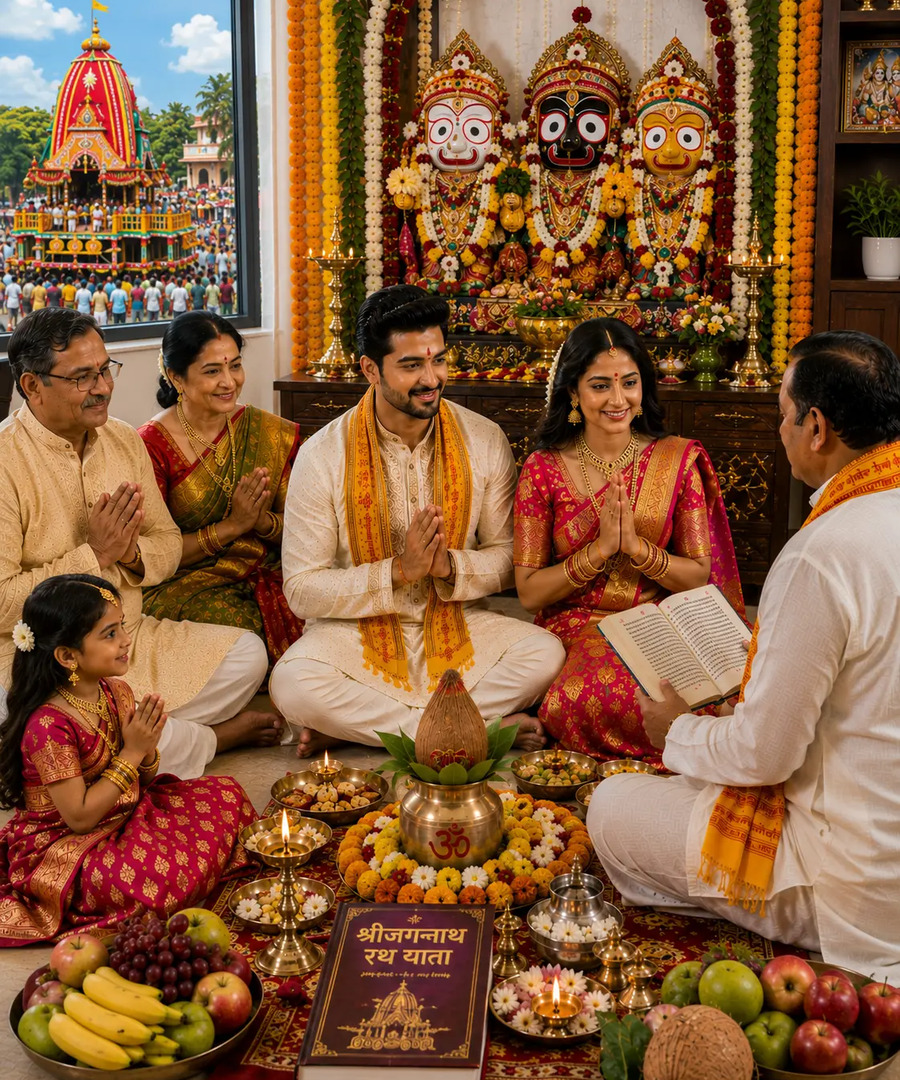
Ashadha Shukla Dwitiya · Devotion, equality & seva
Jagannath Rath Yatra – जगन्नाथ रथ यात्रा
Honour Lord Jagannath, Lord Balabhadra and Goddess Subhadra on their sacred chariot journey. In Hindu tradition, the deities leaving the temple to meet devotees inspires humility, equality, community participation and service. Celebrate at home or locally, with sincere devotion — not promises of miracles or guaranteed outcomes.
Next Rath Yatra · Upcoming date not verified · Ashadha Shukla Dwitiya · local tithi not verified · Puri, Odisha, India
Image placeholder — to be replaced
Puri’s Nandighosha, Taladhwaja and Darpadalana together — verified image awaiting upload
Image placeholder — to be replaced
Devotees safely pulling the chariots on the permitted procession route — verified image awaiting upload
Image placeholder — to be replaced
The Gajapati king’s ceremonial sweeping of the chariots — verified image awaiting upload
Devotion does not require travel or crowds. Home prayer and local seva are welcome. If attending, hydrate, keep children with responsible adults, obey barriers and never climb or approach a moving chariot.
Jagannath Rath Yatra: Story & History
Jagannath — Lord of the universe
In Hindu devotional tradition, Lord Jagannath is associated with Vishnu and Krishna. The distinctive wooden forms worshipped at Puri are central to a living temple tradition with its own ritual practices. Sacred origin accounts are matters of faith; they should not be confused with independently established historical events.
Balabhadra, Subhadra and the shared journey
Lord Balabhadra and Goddess Subhadra accompany Lord Jagannath. Devotional accounts honour them as Krishna’s elder brother and sister. Each has a separate chariot and a distinct identity; Sudarshana also participates in the temple’s festival rites. This shared journey expresses affectionate relationship and collective devotion.
From the main temple to Gundicha
In the Puri tradition, the deities leave the Shree Jagannath Temple and travel along the Bada Danda toward Gundicha Temple. The outward journey is associated with Ashadha Shukla Dwitiya. The temple administration directs the rites; a lunar tithi alone cannot tell a visitor when a procession will actually move.
Darshan beyond the temple
Devotees understand the deities’ appearance outside the temple as an opportunity for wider darshan and shared worship. The festival’s message is often expressed through equality and hospitality. This devotional ideal does not override actual access rules, crowd barriers or the instructions of temple and public-safety authorities.
The Gundicha stay
Gundicha Temple is the destination of the outward journey. Devotional retellings sometimes describe it as a garden or family visit; interpretations differ. The deities stay there during the festival period before their return. Exact annual dates and public access arrangements require official confirmation rather than adding a fixed number of days to this page’s date.
Chhera Pahanra — dignity in service
The Gajapati king performs ceremonial sweeping of the chariots with a golden-handled broom, according to Puri temple tradition. The rite is widely understood as a reminder that even a ruler serves before the divine. Its meaning is humility and seva, not a claim that a person’s social standing determines their worth.
Bahuda and the return-festival rites
Bahuda Yatra is the return journey toward the main temple. The return-festival period includes Suna Besha, the golden adornment, followed by Adhara Pana and Niladri Bije in the Puri sequence. These ceremonies have their own temple rules and dates; they must not be inferred from an unverified calendar entry.
A living tradition, not one universal event
The Shree Jagannath Temple Administration documents Puri’s ceremony and chariot traditions. Rath Yatras elsewhere draw inspiration from Jagannath devotion but may use different routes, chariots and schedules. Community singing, kindness, patient participation and care for public spaces can express the spirit of the festival at home or locally.
Jagannath Rath Yatra Date, Tithi & Schedule
Panchang · Puri, Odisha, India · Asia/Kolkata
Upcoming date not verified
Festival date
Upcoming date not verified
Observance
Ashadha Shukla Dwitiya
Verified local tithi
Not verified
Dwitiya begins
Not verified
Dwitiya ends
Not verified
Local sunrise
Not verified
Observance notes
Not verified
No verified upcoming occurrence is available. Automatic Panchang synchronization is not connected; consult your local Panchang.
The shared verified calendar reads the rolling current year plus nine years. No licensed Panchang calculation/provider is connected, so missing dates, local sunrise and regional rules are not estimated. Puri is this page’s reference location; its calendar information is not universal for other cities. City selection is not currently available.
Puri official procession schedule
Schedule not yet confirmed on this website.
Pahandi Bije
Awaiting a verified annual temple announcement
Chhera Pahanra
Awaiting a verified annual temple announcement
Chariot pulling
Awaiting a verified annual temple announcement
Bahuda and return-festival events
Awaiting a verified annual temple announcement
These are event-specific announcements, separate from tithi or generic puja windows. No official event-data feed is connected and no verified annual schedule is stored here. For other cities, use the relevant organizer’s confirmed event information; no unverified local event listing is published.
This sequence describes the broader Puri festival cycle, not ten ceremonies on one day. Exact annual dates, ceremonial arrangements and timings follow temple announcements. Regional Rath Yatras are not all identical.
1
Snana Yatra
The ceremonial bathing of the deities takes place before Rath Yatra in the Puri festival cycle. It is a temple rite, not an instruction to bathe an image at home or a date calculated here.
2
Anasara
After Snana Yatra, the deities traditionally remain out of ordinary public view during Anasara. Follow temple announcements for darshan arrangements; do not assume normal access continues.
3
Pahandi Bije
The deities are ceremonially brought toward their chariots in Puri’s characteristic procession. The temple describes the order as Sudarshana, Balabhadra, Subhadra and Jagannath. The annual time is confirmed by the temple, not by a puja window.
4
Chhera Pahanra
The Gajapati king ceremonially sweeps the chariots, expressing service and humility. Observe from authorized areas and leave room for the ceremony and staff.
5
Rath pulling toward Gundicha
Devotees pull the chariots along the permitted route toward Gundicha Temple under official direction. Never approach wheels, climb a moving chariot or cross barriers. Participation is optional.
6
Stay at Gundicha Temple
The deities remain at Gundicha Temple during the traditional visit. Consult official announcements for the stay, ceremonies and visitor arrangements; regional events may follow different customs.
7
Bahuda Yatra
The return procession brings the deities back toward the main Jagannath Temple. Treat its date and movement schedule as independently announced information, not an offset from the outward journey.
8
Suna Besha
During the return-festival period the deities receive their traditional golden adornment on the chariots. Public viewing arrangements and timing follow temple announcements.
9
Adhara Pana
A traditional sweet drink is offered in tall pots during the return-festival period, after Suna Besha in the Puri sequence. Temple practice includes breaking the offering pots on the chariots; this is a specialized rite, not a household instruction.
10
Niladri Bije
The deities return to their temple abode, completing the principal chariot-festival cycle. The return includes distinctive temple customs; follow Puri’s annual announcements rather than treating all local Rath Yatras as identical.
The Three Sacred Chariots of Rath Yatra
Lord Jagannath
Nandighosha
नंदीघोष
16 wheels · traditional description
The temple administration describes a red-and-yellow canopy. The chariot’s distinct name, emblems and decoration honour Jagannath’s identity.
Also written Nandighosa.
Lord Balabhadra
Taladhwaja
तालध्वज
14 wheels · traditional description
The temple administration describes a red-and-blue canopy. Its separate identity and decoration distinguish Balabhadra’s chariot in the procession.
Temple-specific descriptions may differ from simplified popular colour accounts.
Goddess Subhadra
Darpadalana
दर्पदलन
12 wheels · traditional description
The temple administration describes a red-and-black canopy. Subhadra travels in her own chariot, with its own traditional decoration.
Also known in some traditions as Devadalana.
Names, wheel counts and canopy descriptions above follow the temple administration’s chariot account. Chariots are newly built each year; measurements and construction specifications are source-dependent and are not guessed here. No unverified chariot photos are shown.
Interactive Puja & Festival Checklist
पूजा और उत्सव तैयारी सूची
An optional aid for home worship or local participation. Event information and travel preparations apply only if you choose to attend; nobody must travel to Puri.
0 of 12 items prepared12 में से 0 सामग्री तैयार
Items depend on family, region and the chosen puja; optional items are not universal requirements. · सामग्री परिवार, क्षेत्र और चुनी हुई पूजा अनुसार बदलती है।
Spiritual Significance of Jagannath Rath Yatra
जगन्नाथ रथ यात्रा का आध्यात्मिक महत्व
Devotion and relationship
Remember Jagannath, Balabhadra and Subhadra through familiar prayers or bhajans. Their shared journey expresses relationship and companionship in Hindu devotion.
Meeting devotees beyond the temple
Devotees see the outward journey as the divine meeting the community. Let that ideal encourage hospitality and kindness without making claims about guaranteed blessings or outcomes.
Humility through Chhera Pahanra
The ruler’s ceremonial service invites everyone to value honest work and treat others with dignity. A simple act of cleaning or helping can be meaningful seva.
Community and shared devotion
Patient participation, respectful singing and helping others create room for shared worship. Nobody needs to attend a crowded procession to express sincere devotion.
The Gundicha journey
The outward visit and return are cherished features of Puri’s tradition. Reflect on welcome, companionship and renewal without presenting devotional interpretations as proven historical facts.
Equality, kindness and seva
Share food safely, support reliable community work and respect public spaces. Give according to your means; no donation or ritual guarantees a worldly result.
12 Rashi Guidance & Puja Impact
बारह राशियों के लिए आध्यात्मिक चिंतन
Optional traditional spiritual reflections, not certainty, predictions or professional advice. No wealth, health, marriage, employment or future outcome is guaranteed.
Mesh (Aries) · मेष
Spiritual guidance
Turn enthusiasm into patient participation.
Reflection
A chariot journey depends on coordinated effort, not rushing ahead.
Practice for the day
Let others pass and follow staff directions if attending.
Connection to Rath Yatra
Shared devotion needs patience more than displays of force.
Vrishabh (Taurus) · वृषभ
Spiritual guidance
Make hospitality your offering to Jagannath.
Reflection
Comfort becomes kindness when it is shared.
Practice for the day
Prepare simple prasad and offer it safely to a neighbour.
Connection to Rath Yatra
The Gundicha visit invites reflection on welcome and care.
Mithun (Gemini) · मिथुन
Spiritual guidance
Use words to connect rather than spread rumours.
Reflection
Reliable information is a service to fellow devotees.
Practice for the day
Read an official announcement before sharing any event time.
Connection to Rath Yatra
Thoughtful communication helps a community journey together.
Kark (Cancer) · कर्क
Spiritual guidance
Honour the bonds symbolized by the three deities.
Reflection
Care for family can widen into care for strangers.
Practice for the day
Plan water, shade and adult supervision for children.
Connection to Rath Yatra
Companionship matters throughout the sacred journey.
Singh (Leo) · सिंह
Spiritual guidance
Let leadership become humble service.
Reflection
Chhera Pahanra places dignity in service, not status.
Practice for the day
Help clean a shared space without seeking credit.
Connection to Rath Yatra
The Gajapati’s ceremonial sweeping is a reminder to serve.
Kanya (Virgo) · कन्या
Spiritual guidance
Prepare carefully without demanding perfection.
Reflection
Small practical arrangements can make worship calmer.
Practice for the day
Check your optional checklist and verified access instructions.
Connection to Rath Yatra
The chariot festival brings many distinct tasks into shared purpose.
Tula (Libra) · तुला
Spiritual guidance
Practise equality through everyday courtesy.
Reflection
Shared darshan asks us to respect another person’s space.
Practice for the day
Make room for someone who needs help; do not push or cut queues.
Connection to Rath Yatra
The deities’ public journey inspires inclusion and fairness.
Vrishchik (Scorpio) · वृश्चिक
Spiritual guidance
Replace possessiveness with trust and restraint.
Reflection
Devotion need not become a struggle for the closest view.
Practice for the day
Choose a safe viewing area or quiet home prayer.
Connection to Rath Yatra
Inner sincerity does not depend on proximity to a chariot.
Dhanu (Sagittarius) · धनु
Spiritual guidance
Learn Puri’s traditions with an open mind.
Reflection
Respect grows when regional differences are understood.
Practice for the day
Read the temple’s account of Gundicha and Bahuda.
Connection to Rath Yatra
A sacred journey can inspire attentive learning, not assumptions.
Makar (Capricorn) · मकर
Spiritual guidance
Build steady seva beyond one festival day.
Reflection
Large traditions are sustained through patient work.
Practice for the day
Commit to a small regular volunteer task within your capacity.
Connection to Rath Yatra
The annual chariot preparations exemplify collective dedication.
Kumbh (Aquarius) · कुम्भ
Spiritual guidance
Use community-minded thinking for practical good.
Reflection
Inclusion means considering people unable to travel.
Practice for the day
Share a verified viewing option or organize a small local bhajan.
Connection to Rath Yatra
Jagannath devotion can connect people beyond a single place.
Meen (Pisces) · मीन
Spiritual guidance
Let tenderness become prayer and concrete kindness.
Reflection
Compassion is more meaningful when expressed in action.
Practice for the day
Sing a familiar bhajan, then help someone with a simple need.
Connection to Rath Yatra
Devotion and seva can travel together like the sacred procession.
Rath Yatra Attendance, Seva & Safety
भागीदारी, सेवा और सुरक्षा
Home or local observance is welcome
Offer flowers, light a diya safely, listen to familiar bhajans or visit a local temple if comfortable. Travel to Puri, chariot pulling and large-crowd attendance are never requirements.
Follow verified announcements
Use the temple administration and local authorities for Puri, and the relevant organizer for another city. Confirm route, access and transport information yourself; schedules and crowd conditions can change.
Crowds, weather and hydration
Carry safe drinking water, consider heat and rain, and plan breaks and a meeting point. Seek assistance if unwell. Do not assume crowd density or transport availability is guaranteed.
Children and vulnerable visitors
Keep children with responsible adults and agree on what to do if separated. Consider a quieter local or home observance for anyone uncomfortable with crowds.
Moving chariots and barriers
Stay away from wheels and moving chariots. Never climb, push toward ropes or cross barriers. Follow instructions from police, event staff and temple authorities; do not attempt unsafe access for a closer view.
Seva and public spaces
Give within your means through trusted efforts. Avoid litter, dispose of offerings responsibly, respect residents and leave access clear for emergency services. Keep lamps on heat-resistant surfaces and supervise flames and incense.
Frequently Asked Questions About Jagannath Rath Yatra
Temple accounts document Puri’s living traditions; devotional interpretations remain matters of faith. These cultural references do not establish an annual event time. The existing devotional artwork is illustrative, not evidence of an actual Puri procession. No images, mantras, dates or event announcements were invented for this page.