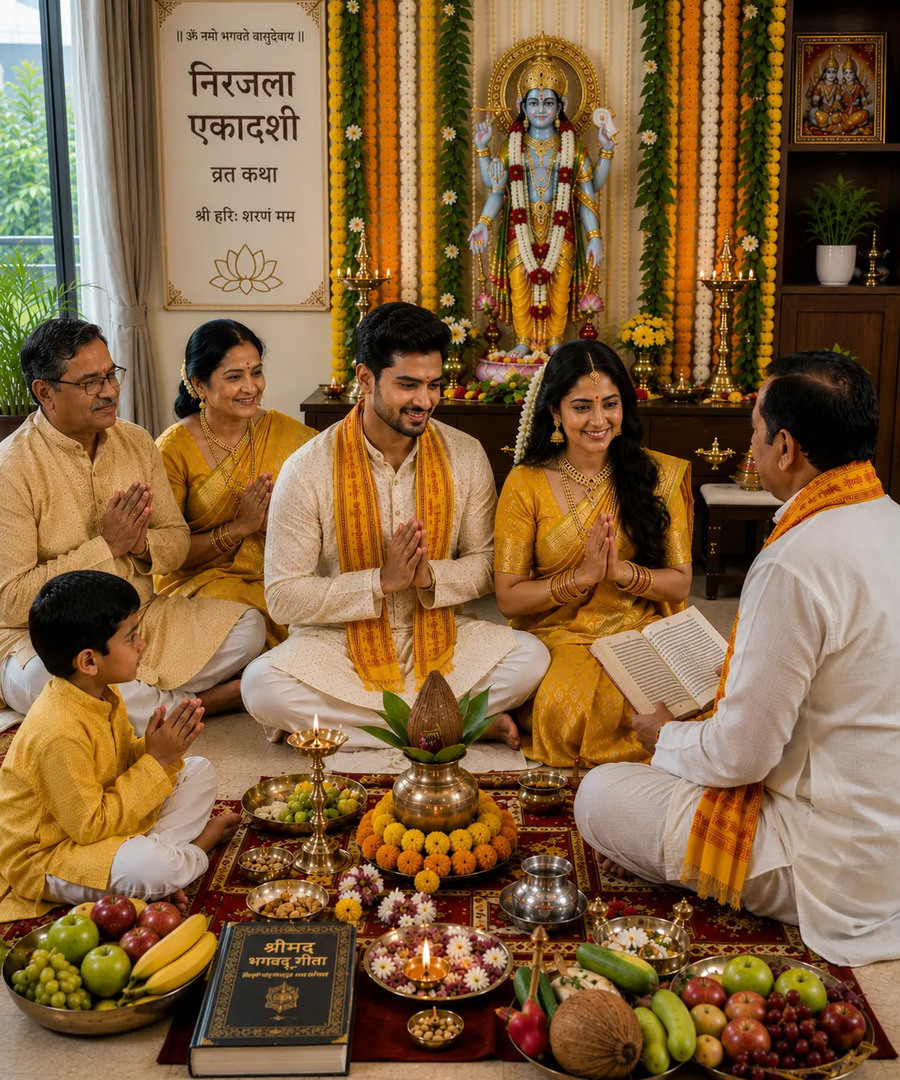
An Ekadashi dedicated to Lord Vishnu, traditionally known as Bhimseni and Pandava Nirjala Ekadashi after Bhima’s observance on Sage Vyasa’s advice. It is a day of devotion, discipline, charity, self-control and spiritual reflection — offered within each person’s capacity. Its special merit is a matter of faith; no wealth, health or salvation is guaranteed.
Next Nirjala Ekadashi (Smarta) · Upcoming date not verified · Jyeshtha Shukla Ekadashi · local tithi not verified · Dwadashi Parana: Not verified · New Delhi, India
Image placeholder — to be replaced
Respectful devotional depiction of Lord Vishnu — approved image awaiting upload
Image placeholder — to be replaced
Lord Vishnu with Tulsi leaves and flower offerings — approved image awaiting upload
Image placeholder — to be replaced
Traditional Ekadashi puja thali with diya, flowers, fruits and kalash — approved image awaiting upload
Image placeholder — to be replaced
Community water-pot donation or drinking-water distribution in summer — approved image awaiting upload
01 / 05
Lord Vishnu — the preserver
भगवान विष्णु
Health & safety first
The strict Nirjala fast (no food or water) is a traditional option, not a requirement, and not appropriate for everyone. People with health conditions, anyone on medication, pregnant or breastfeeding people, children, older adults and anyone at increased risk should avoid a waterless fast unless a qualified healthcare professional confirms it is safe. Never skip prescribed medication or ignore thirst. Stop, drink water and seek medical help if you feel dizzy, faint, confused or very weak. A fruit-based or partial fast, or prayer without fasting, is fully sincere devotion.
Nirjala Ekadashi: Story & History
A traditional account, not a scientific claim
The stories below are cherished Hindu religious traditions, found in Purana-related tellings and retold in families and temples. Details vary between versions; they are presented as sacred narratives, not independently verified history or medical advice.
What “Nirjala” means
“Nir” means without and “jala” means water. Nirjala Ekadashi is traditionally associated with a strict fast kept without food or water from sunrise on Ekadashi until Parana on Dwadashi. Many devotees today observe gentler forms suited to their health and circumstances.
Bhima’s difficulty
Tradition describes Bhima, the strongest of the Pandavas, as having a great appetite. While his family kept every Ekadashi fast, he found it impossible to go without food twice a month and worried that he could not share in the devotion of his brothers and Draupadi.
Sage Vyasa’s counsel
According to the account, Bhima approached Sage Vyasa for guidance. Vyasa advised him to observe one Ekadashi with complete dedication — the Jyeshtha Shukla Ekadashi — without food or water, and taught that sincere observance of this one day would carry the merit of all the Ekadashis of the year.
Bhimseni and Pandava Nirjala Ekadashi
Because of Bhima’s observance, the day is also called Bhimseni or Bhima Ekadashi, and Pandava Nirjala Ekadashi. The story reassures devotees that devotion can take a form that fits one’s nature, offered sincerely and within one’s capacity.
Lord Vishnu and Jyeshtha Shukla Ekadashi
Every Ekadashi is dedicated to Lord Vishnu. Nirjala Ekadashi falls on the eleventh tithi of the bright fortnight of Jyeshtha, usually in the hot season of May or June. Because a tithi does not match a civil date exactly, its observance day depends on local sunrise and Panchang rules.
Devotion, discipline and charity
The observance is traditionally marked by prayer, japa, bhajan, Vishnu Sahasranama recitation, reflection and charity. Because the fast falls in summer, offering drinking water, sherbet, fans or water pots to others is a cherished custom that turns personal restraint into care for others.
The belief in special merit
Many devotees believe this vrat carries special spiritual merit. This is a matter of faith. It does not guarantee wealth, health, forgiveness or salvation, and devotion never requires anyone to risk their health.
Nirjala Ekadashi Date, Tithi & Parana Muhurat
Smarta · New Delhi, India · Asia/Kolkata
Upcoming date not verified
Fasting date
Upcoming date not verified
Observance
Jyeshtha Shukla Ekadashi
Verified local Tithi
Not verified
Ekadashi Tithi begins
Not verified
Ekadashi Tithi ends
Not verified
Dwadashi sunrise
Not verified
Dwadashi Parana window
Not verified
Observance notes
Not verified
No verified upcoming occurrence is available. Automatic Panchang synchronization is not connected; consult your local Panchang.
Parana is traditionally performed on Dwadashi within the prescribed window, after Hari Vasara ends. Smarta and Vaishnava dates can differ when Ekadashi overlaps Dashami or extends past sunrise; each tradition is read only from its own verified record and never substituted. New Delhi is the configured reference city; this page does not yet offer city selection, and its Parana window is not valid for other cities. Dates come from the shared verified calendar cache within the automatically rolling current-year-plus-nine window; no Panchang provider or calculation library is connected, so no annual date or timing is calculated or guessed. Confirm with a trusted city-specific Panchang.
Nirjala Ekadashi Puja Vidhi – Step-by-Step
निर्जला एकादशी पूजा विधि
Practices vary by region and family; these steps are guidance, not compulsory rules. The strict traditional fast means no food and no water, but it is not appropriate for everyone — a fruit-based or partial fast, or prayer without fasting, is equally welcome.
Health & safety first
The strict Nirjala fast (no food or water) is a traditional option, not a requirement, and not appropriate for everyone. People with health conditions, anyone on medication, pregnant or breastfeeding people, children, older adults and anyone at increased risk should avoid a waterless fast unless a qualified healthcare professional confirms it is safe. Never skip prescribed medication or ignore thirst. Stop, drink water and seek medical help if you feel dizzy, faint, confused or very weak. A fruit-based or partial fast, or prayer without fasting, is fully sincere devotion.
1
Prepare the puja area
Clean a calm space and arrange the samagri your family uses on a stable surface with a clean cloth.
2
Bathe and dress cleanly
Bathe and wear clean clothes according to personal tradition.
3
Place Lord Vishnu
Place an image or idol of Lord Vishnu respectfully on the altar.
4
Light a diya and offer
Light a diya in a heat-resistant holder, away from fabric and children. Offer flowers, Tulsi leaves where appropriate in your tradition, fruits and customary naivedya.
5
Pray to Lord Vishnu
Offer prayers to Lord Vishnu and recite devotional prayers familiar to your family or taught by a trusted teacher. No mantra is invented here.
6
Read or hear the katha
Read or listen to the traditional Bhima and Vyasa vrat katha from a recognised source.
7
Japa, bhajan and reflection
Spend time in japa, meditation, bhajan or Vishnu Sahasranama recitation, at a pace that is comfortable and restful in the heat.
8
Practise charity
Donate water, sherbet, fruit or refreshments to people in need where appropriate, or support a trusted community water-distribution effort. Give within your means.
9
Continue within your capacity
Continue the observance according to your chosen tradition and personal capacity — strict, partial, fruit-based or prayer without fasting. Drink water and stop if you feel unwell.
10
Parana on Dwadashi
If following the vrat, break the fast on Dwadashi during the Parana window applicable to your city, beginning gently with water and light food.
Interactive Puja Samagri Checklist
पूजा सामग्री सूची
An optional preparation aid. It does not imply that a waterless fast is required; keep safe drinking water available.
0 of 13 items prepared13 में से 0 सामग्री तैयार
Items depend on family, region and the chosen puja; optional items are not universal requirements. · सामग्री परिवार, क्षेत्र और चुनी हुई पूजा अनुसार बदलती है।
Spiritual Significance of Nirjala Ekadashi
आध्यात्मिक महत्व
Devotion to Lord Vishnu
Ekadashi is a day of remembrance of Lord Vishnu, the preserver in Hindu tradition. Prayer, japa and quiet reflection express that devotion more than any particular degree of hardship.
The teaching of Bhima and Vyasa
Vyasa’s counsel shows compassion for human limits: devotion is offered as one is able, sincerely. It is a reminder that spiritual practice should fit the person.
Discipline and mindful restraint
Restraint in food, speech and habits can build self-awareness. Mindful discipline is about attention and intention, not about punishing the body.
Prayer, reflection and compassion
The day invites honest reflection, patience and kindness towards family, neighbours and strangers.
Charity and the gift of drinking water
In the summer heat, offering drinking water is a deeply valued act of service. Never withhold water from anyone who needs it, including yourself.
Respect for physical limits
Responsible practice honours the body. Safer forms of observance are fully valid, and medical advice and prescribed medication always come first.
Belief in spiritual merit
Tradition holds that sincere observance carries special merit. This is a matter of faith; it does not guarantee wealth, health, forgiveness, salvation or any worldly outcome.
12 Rashi Guidance & Puja Impact
बारह राशियों के लिए आध्यात्मिक चिंतन
Optional reflections inspired by traditional zodiac symbolism — not certainty or professional advice. No wealth, health, marriage, employment or future result is predicted or guaranteed.
Mesh (Aries) · मेष
Spiritual guidance
Let energy become steady devotion rather than a test of endurance.
Reflection
Discipline is strongest when it is calm, not competitive.
Practice for the day
Choose an observance you can keep safely and spend ten quiet minutes in japa.
Connection to Nirjala Ekadashi
Bhima’s story honours sincerity over proving strength.
Vrishabh (Taurus) · वृषभ
Spiritual guidance
Reflect on your relationship with comfort and nourishment.
Reflection
Gentle restraint can deepen gratitude for simple food.
Practice for the day
Prepare a light, wholesome Parana meal in advance and share fruit with someone.
Connection to Nirjala Ekadashi
Like Bhima, honour your nature while offering what you can.
Mithun (Gemini) · मिथुन
Spiritual guidance
Rest restless thoughts in focused remembrance.
Reflection
Mindful speech is a form of self-control.
Practice for the day
Listen to or read a portion of Vishnu Sahasranama without multitasking.
Connection to Nirjala Ekadashi
Vyasa’s counsel came through attentive listening.
Kark (Cancer) · कर्क
Spiritual guidance
Turn care for family into care for wider community.
Reflection
Compassion includes looking after your own wellbeing.
Practice for the day
Ensure elders and children in your home have water and a safe alternative to fasting.
Connection to Nirjala Ekadashi
Charity of water is central to this day’s spirit.
Singh (Leo) · सिंह
Spiritual guidance
Lead with humility and generosity.
Reflection
True strength includes knowing one’s limits.
Practice for the day
Organise or support a water station for workers or passers-by, in shade.
Connection to Nirjala Ekadashi
Bhima, the mightiest Pandava, sought guidance humbly.
Kanya (Virgo) · कन्या
Spiritual guidance
Bring order and care to preparation without perfectionism.
Reflection
Sincerity matters more than flawless ritual.
Practice for the day
Arrange the samagri the evening before and note your city’s verified Parana window.
Connection to Nirjala Ekadashi
Vyasa offered a practical path, not an impossible standard.
Tula (Libra) · तुला
Spiritual guidance
Seek balance between devotion and wellbeing.
Reflection
Harmony means respecting both tradition and the body.
Practice for the day
Agree with family on an observance level that is safe for each person.
Connection to Nirjala Ekadashi
The story honours different capacities within one family.
Vrishchik (Scorpio) · वृश्चिक
Spiritual guidance
Use inward intensity for honest self-reflection.
Reflection
Self-restraint can reveal habits worth changing.
Practice for the day
Write down one habit to release and one kindness to begin.
Connection to Nirjala Ekadashi
Discipline here aims at inner clarity, not hardship.
Dhanu (Sagittarius) · धनु
Spiritual guidance
Explore the meaning behind the vrat with an open mind.
Reflection
Learning deepens devotion and respect for other traditions.
Practice for the day
Read the Bhima–Vyasa katha and discuss how Smarta and Vaishnava customs differ.
Connection to Nirjala Ekadashi
Vyasa, a great teacher, guided with wisdom and compassion.
Makar (Capricorn) · मकर
Spiritual guidance
Practise patient, sustainable discipline.
Reflection
Consistency over time matters more than one extreme day.
Practice for the day
Commit to one small weekly act of charity beyond this festival.
Connection to Nirjala Ekadashi
The vrat is a reminder of steady devotion through the year.
Kumbh (Aquarius) · कुम्भ
Spiritual guidance
Express devotion through community service.
Reflection
Serving others is a living form of prayer.
Practice for the day
Donate a water pot or contribute to a trusted drinking-water initiative.
Connection to Nirjala Ekadashi
Water donation is a cherished Nirjala Ekadashi custom.
Meen (Pisces) · मीन
Spiritual guidance
Let sensitivity become peaceful prayer and kindness.
Reflection
Compassion grows when we feel the needs of others.
Practice for the day
Spend quiet time in bhajan, then offer water or refreshment to someone in the heat.
Connection to Nirjala Ekadashi
Devotion to Vishnu flows naturally into care for all beings.
Vrat Rules, Parana & Important Precautions
व्रत नियम, पारण और सावधानियाँ
The traditional strict observance
Traditionally, the strict Nirjala vrat means no food and no water from Ekadashi sunrise until Dwadashi Parana. This is a demanding practice and is not compulsory for every devotee.
Gentler observances are fully valid
Many families keep a phalahar (fruit-based) fast, a partial fast with water, a single simple meal, or prayer and charity without fasting. Choose according to your health, circumstances and family tradition.
Health comes first
People with health conditions, anyone taking medication, pregnant or breastfeeding people, children, older adults and anyone at increased risk should avoid a waterless fast unless a qualified healthcare professional confirms it is safe. Never skip prescribed medication.
Heat and dehydration warning
This vrat falls in the hot season. Do not ignore thirst. Stop fasting, drink water and seek medical help if you notice dizziness, fainting, confusion, rapid heartbeat, very dark urine, severe headache or extreme weakness. Devotion does not require risking your health.
Dwadashi Parana window
Parana is traditionally performed on Dwadashi within the applicable window, after Hari Vasara ends. Exact timings depend on your city’s sunrise and tithi boundaries. Break the fast gently with water and light food.
Consult your local Panchang
Ekadashi dates and Parana windows vary by city and sometimes differ between Smarta and Vaishnava traditions. Confirm with a trusted city-specific Panchang or your family priest.
Charity and water donation
Offer drinking water, refreshments or water pots to people in need. Never withhold water from anyone who needs it — including children, workers, the elderly and yourself.
The Bhima and Vyasa account is presented as Hindu religious tradition; versions differ. No mantras or scriptural quotations are invented. Health guidance is general and does not replace advice from a qualified professional.