Ashadha Purnima · Vyasa Purnima · Gratitude & learning

Guru Purnima – गुरु पूर्णिमा

Honour the gurus, teachers and mentors who guide us toward knowledge and wisdom. Hindu tradition associates the day with Maharishi Ved Vyasa, so it is also called Vyasa Purnima. It invites gratitude, learning, humility and self-reflection. Hindu, Buddhist and Jain communities observe the season in their own distinct ways.

Next Guru Purnima · Upcoming date not verified · Ashadha Purnima · local tithi not verified · New Delhi, India

Image placeholder — to be replaced

Respectful traditional depiction of Maharishi Ved Vyasa — verified image awaiting upload

01 / 05

Maharishi Ved Vyasa

महर्षि वेद व्यास

Gratitude, not blind obedience. You do not need a living guru, costly gifts or one specific ritual. Honour any teacher or mentor in a way that fits your tradition, means and judgment.

Guru Purnima: Story & History

Maharishi Ved Vyasa in Hindu tradition

Hindu tradition honours Maharishi Krishna Dvaipayana Vyasa as the sage associated with arranging the Vedas and composing the Mahabharata, and traditionally with the Puranas. These attributions are matters of religious tradition; historians date and describe these texts through their own methods, and the two kinds of account should not be confused.

Why it is called Vyasa Purnima

Ashadha Purnima is widely observed as Vyasa Purnima. Tradition associates the day with honouring Vyasa as an Adi Guru, a foundational teacher. Many communities therefore offer Vyasa Puja and remember the lineages through which teachings were preserved.

The guru-shishya relationship

The relationship between teacher (guru) and student (shishya) is central in many Indian traditions. Ideally it rests on sincere teaching, disciplined study, mutual respect and ethical conduct. Gratitude toward a teacher is valued — but it does not mean surrendering personal judgment or safety.

Teachers as carriers of knowledge

Before printed books, knowledge, values, music, ritual practice and philosophy were often passed on orally from teacher to student. Guru Purnima recognises everyone who carries that work forward today: parents, schoolteachers, mentors, scholars and spiritual guides.

Ashrams, schools and spiritual communities

Ashrams and sampradayas may hold Guru Puja, satsang, recitation and seva. Schools and music or dance institutions often thank their teachers. Customs, prayers and timings differ by community; there is no single universal ritual.

Buddhist associations

In many Buddhist traditions, the full moon of Asalha (Ashadha) commemorates the Buddha’s first sermon at Sarnath after his enlightenment, setting the Wheel of Dhamma in motion. Buddhist calendars and names for the day (such as Asalha Puja or Dharma Chakra Day) differ, and the date may differ from Hindu Panchang observance.

Jain observance

Some Jain communities associate this period with honouring teachers and with the approach of Chaturmas. Practices vary between Jain traditions and are not identical to Hindu Vyasa Puja.

The enduring message

Across traditions, the shared themes are gratitude, humility, disciplined learning, ethical guidance and passing knowledge on generously to others.

Guru Purnima Date, Tithi & Puja Muhurat

Hindu Panchang · New Delhi, India · Asia/Kolkata

Upcoming date not verified

Festival date
Upcoming date not verified
Observance
Ashadha Purnima (Hindu calendar)
Verified local tithi
Not verified
Purnima begins
Not verified
Purnima ends
Not verified
Local sunrise
Not verified
Puja muhurat
Not verified
Observance notes
Not verified

No verified upcoming occurrence is available. Automatic Panchang synchronization is not connected; consult your local Panchang.

The shared verified calendar reads the rolling current year plus nine years. No licensed Panchang provider is connected, so missing dates, sunrise and muhurat are never estimated. New Delhi is this page’s reference location; its timing is not universal, and city selection is not currently available.

Buddhist Asalha Puja and Jain observances follow their own calendars and may fall on a different date; this date applies only to the Hindu Ashadha Purnima observance.

Guru Purnima Puja Vidhi – Step-by-Step

गुरु पूर्णिमा पूजा विधि

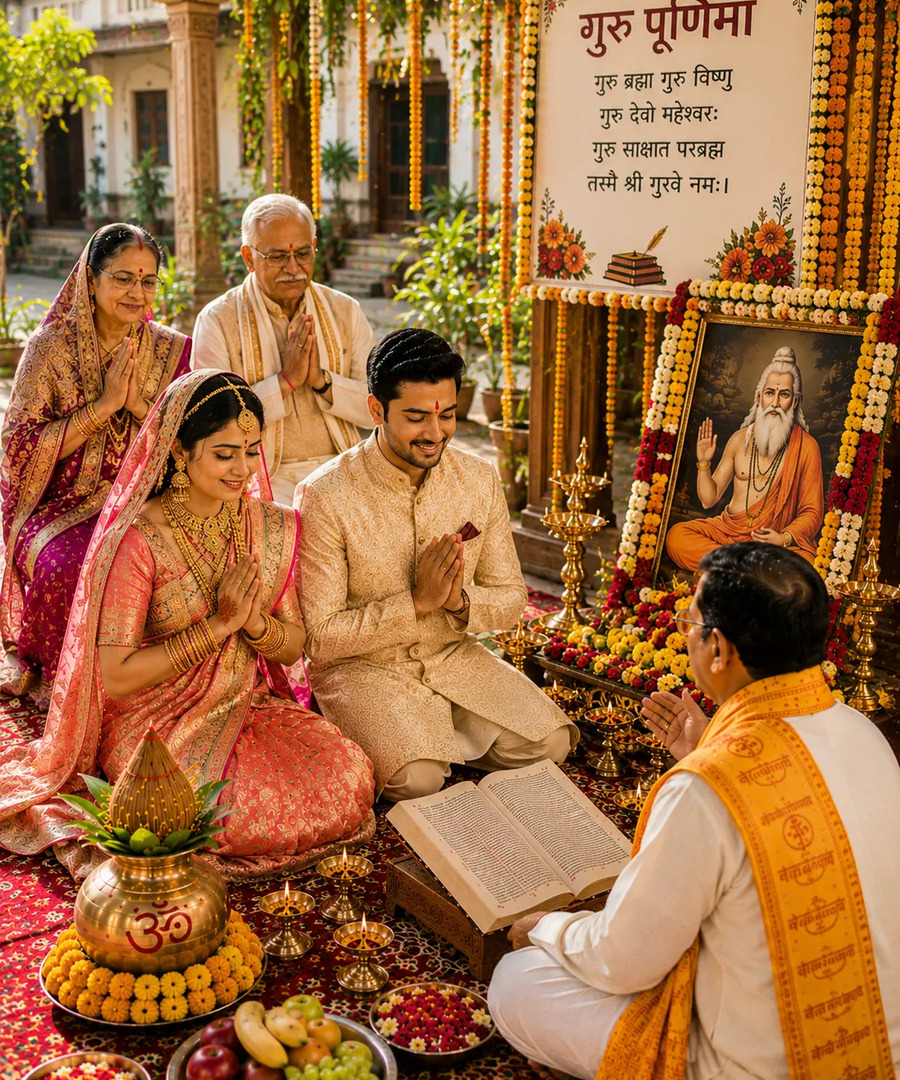
Rituals vary by family, ashram and tradition. You do not need a living guru or one prescribed ritual; adapt these steps respectfully. No mantra or offering is compulsory.

  1. 1

    Prepare the space

    Clean the puja or reflection area and gather the items you choose to use.

  2. 2

    Personal preparation

    Bathe and wear clean clothes according to your personal or family tradition.

  3. 3

    Place an image or symbol

    Place an image of Maharishi Ved Vyasa, a respected guru or another appropriate symbol, if customary. A book of teachings can also serve as a focus.

  4. 4

    Offer flowers and a diya

    Offer flowers, light a diya safely on a heat-resistant surface, and add other items only according to family or ashram practice.

  5. 5

    Express gratitude

    Offer prayers or simply express thanks to your guru, teacher, mentor or spiritual guide — in person, by message or silently.

  6. 6

    Read or listen to teachings

    Read or listen to teachings from reliable, attributed sources rather than unverified quotations.

  7. 7

    Reflect on lessons

    Reflect on what you have learned and how to apply it ethically in daily life.

  8. 8

    Dakshina or support, if desired

    Offer dakshina, charity or support for education according to your means. Nothing costly is compulsory.

  9. 9

    Study or meditate

    Spend time in study, meditation or quiet reflection.

  10. 10

    Conclude with a commitment

    Close with gratitude and one practical commitment to keep learning and helping others.

Interactive Puja & Gratitude Checklist

पूजा और आभार सूची

An optional preparation aid. Tick items as you go; your progress is saved on this device.

0 of 10 items prepared10 में से 0 सामग्री तैयार

Items depend on family, region and the chosen puja; optional items are not universal requirements. · सामग्री परिवार, क्षेत्र और चुनी हुई पूजा अनुसार बदलती है।

Spiritual Significance of Guru Purnima

गुरु पूर्णिमा का आध्यात्मिक महत्व

Gratitude toward teachers

The day invites thanks to everyone who has guided us — family, teachers, mentors and spiritual guides.

Maharishi Ved Vyasa

Tradition honours Vyasa for preserving and organising sacred knowledge, making him a symbol of the teacher’s role in sustaining a culture of learning.

Knowledge, wisdom and discernment

Learning is valued alongside humility and discernment: the ability to question thoughtfully and tell sound teaching from claims that lack integrity.

The teacher’s responsibility

A teacher’s role is to guide ethically, honestly and without exploitation. Respect is earned through integrity.

The student’s responsibility

Students are encouraged to learn attentively, respectfully and with their own judgment intact — never through blind obedience.

Lifelong learning

Guru Purnima is a reminder that learning and self-reflection continue throughout life.

Sharing knowledge

Charity, service and teaching others what you know extend the gift you received.

Respect for many traditions

Hindu, Buddhist and Jain communities — and secular educational institutions — honour teachers in their own ways. No one tradition’s practice is presented here as universal.

12 Rashi Guidance & Puja Impact

बारह राशियों के लिए चिंतन

Optional traditional astrological reflection, not certainty or a substitute for personal judgment. No wealth, health, marriage, employment or future outcome is predicted or guaranteed.

Mesh (Aries) · मेष

Spiritual guidance
Let eagerness become patient study.
Reflection
Learning deepens when you slow down enough to listen.
Practice for the day
Spend 20 minutes on one topic without switching tasks.
Connection to Guru Purnima
The guru-shishya bond values steady effort over haste.

Vrishabh (Taurus) · वृषभ

Spiritual guidance
Value the teachers who built your foundations.
Reflection
Gratitude grows when we remember who gave us stability.
Practice for the day
Write a thank-you note to an early teacher or parent.
Connection to Guru Purnima
Guru Purnima honours those who laid the groundwork.

Mithun (Gemini) · मिथुन

Spiritual guidance
Check sources before you share a teaching.
Reflection
Discernment protects wisdom from misquotation.
Practice for the day
Verify one quotation you like before passing it on.
Connection to Guru Purnima
Vyasa’s legacy is tied to preserving knowledge carefully.

Kark (Cancer) · कर्क

Spiritual guidance
Honour the gentle mentors in your life.
Reflection
Many of our first lessons came through care, not classrooms.
Practice for the day
Call a family elder and ask what they learned from their teachers.
Connection to Guru Purnima
The day recognises every form of guidance.

Singh (Leo) · सिंह

Spiritual guidance
Lead by learning in public.
Reflection
Humility makes leadership trustworthy.
Practice for the day
Ask someone junior to teach you a skill they know well.
Connection to Guru Purnima
A good student remains humble even when respected.

Kanya (Virgo) · कन्या

Spiritual guidance
Turn careful habits into a study plan.
Reflection
Small, consistent practice is how mastery forms.
Practice for the day
Set one measurable learning goal for the next month.
Connection to Guru Purnima
Disciplined learning is central to the festival’s values.

Tula (Libra) · तुला

Spiritual guidance
Seek balanced perspectives.
Reflection
Wisdom weighs different views fairly.
Practice for the day
Read one viewpoint from a tradition other than your own.
Connection to Guru Purnima
Guru Purnima respects many lineages of teaching.

Vrishchik (Scorpio) · वृश्चिक

Spiritual guidance
Look inward with honesty.
Reflection
Self-reflection reveals what we still need to learn.
Practice for the day
Journal about one lesson you resisted and why.
Connection to Guru Purnima
The inner student is honoured alongside outer teachers.

Dhanu (Sagittarius) · धनु

Spiritual guidance
Explore wisdom texts with an open, questioning mind.
Reflection
Faith and inquiry can walk together.
Practice for the day
Read a short passage from an attributed translation and note one question.
Connection to Guru Purnima
Vyasa is remembered as a teacher of vast knowledge.

Makar (Capricorn) · मकर

Spiritual guidance
Mentor someone who is starting out.
Reflection
Responsibility includes passing on what we know.
Practice for the day
Offer an hour of guidance to a student or colleague.
Connection to Guru Purnima
Sharing knowledge continues the guru tradition.

Kumbh (Aquarius) · कुम्भ

Spiritual guidance
Widen access to learning.
Reflection
Knowledge is most powerful when shared fairly.
Practice for the day
Donate a book or support a community education effort within your means.
Connection to Guru Purnima
Supporting education is a meaningful form of dakshina.

Meen (Pisces) · मीन

Spiritual guidance
Make quiet space for contemplation.
Reflection
Patience allows insight to settle.
Practice for the day
Sit in silence for ten minutes and reflect on a teaching.
Connection to Guru Purnima
Meditation and reflection are traditional Guru Purnima practices.

Guru Dakshina, Learning & Important Considerations

गुरु दक्षिणा और महत्वपूर्ण बातें

Traditional forms of guru dakshina

Dakshina has traditionally included offerings such as flowers, fruit, cloth, service or a gift given to a teacher with respect. Forms differ widely across families and communities.

Offer according to your means

Give only what you can comfortably afford. Expensive gifts or payments are not compulsory for anyone.

Non-monetary gratitude

Sincere effort, service, a thoughtful note, and applying what you have learned are meaningful ways to honour a teacher.

Supporting education

Donating books, sponsoring a student, or volunteering to teach helps widen access to knowledge.

Respectful conduct

Be punctual, attentive and courteous in learning communities, and respect others’ beliefs.

Ethical boundaries and safe learning

Gratitude never requires accepting exploitation, coercion, financial pressure or harm. Keep your independent judgment, set boundaries, and seek help from trusted people or authorities if a learning environment feels unsafe.

Frequently Asked Questions About Guru Purnima

Related Festivals

Sources & Tradition Notes

Traditional attributions to Vyasa are matters of faith, distinct from historical scholarship. No scriptural quotations, mantras, dates or images were invented for this page; the existing artwork is illustrative.

Honour your teachers with gratitude