Surya · Light, gratitude & renewal

Ratha Saptami

रथ सप्तमी

Honour Lord Surya and the traditional seven-horse chariot through gratitude for light, renewal and daily discipline. Associated with Magha Shukla Saptami and also called Surya Jayanti, Ratha Saptami is observed through varied household and regional traditions, with timing guided by a trusted local Panchang.

Upcoming date not verified · New Delhi, India

Book Pandit Ji
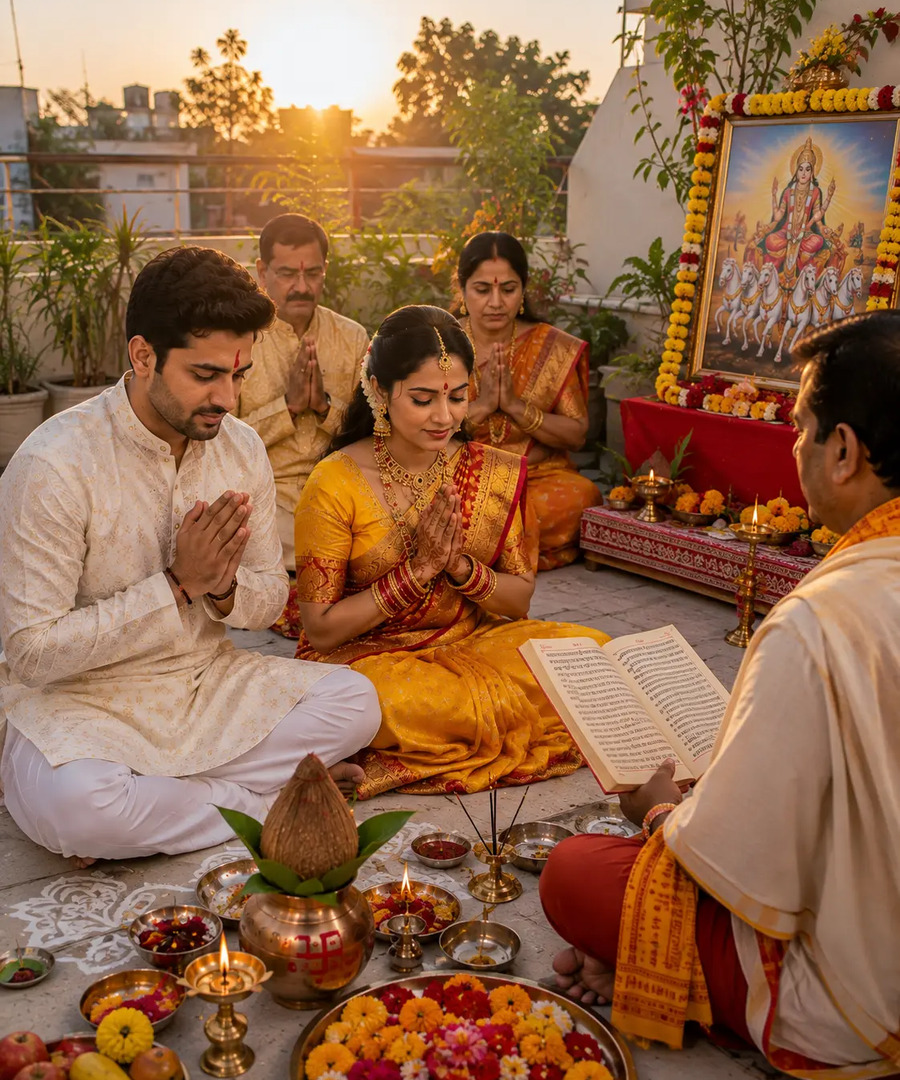
Existing household Surya Puja scene with a framed image of Surya riding a horse-drawn chariot

01 / 05

Lord Surya and the seven-horse chariot

सूर्य देव का सप्ताश्व रथ

Story & History of Ratha Saptami

Surya Dev and gratitude for light

Ratha Saptami honours Lord Surya in Hindu devotional traditions. The Sun’s light supports daily life, and the observance invites gratitude, attentive worship and a renewed daily rhythm. Devotional associations should not be treated as medical advice or a promise of health, wealth or any material result.

The chariot and its seven horses

Surya is traditionally represented riding a chariot drawn by seven horses. The chariot is a sacred image of the Sun’s movement and radiance. Interpretations of the horses differ across traditions; this guide does not prescribe a single meaning, turn symbolism into astronomy, or assign horses to zodiac signs.

Magha Shukla Saptami

The festival is associated with Saptami, the seventh lunar Tithi of Magha’s bright fortnight. A Tithi can begin or end between sunrises and is not equivalent to a midnight-to-midnight date. The local festival day and bathing period require a reliable Panchang with the appropriate sunrise-based and regional observance convention.

Surya Jayanti as a devotional observance

Ratha Saptami is also called Surya Jayanti in devotional practice. The name expresses a traditional celebration of Surya; it is not an independently documented historical birth date. Regional accounts and forms of worship vary, and no invented scripture quotation or historical origin is offered here.

A traditional dawn bath

Some traditions observe a bath around dawn, with an exact period specified by their local Panchang. Arka leaves feature in some regional customs, but they are not a universal requirement. A safe home bath or an adapted observance can be appropriate; entering a river, enduring cold water or using potentially irritating plant materials is not compulsory.

Arghya and worship

Where customary, devotees offer clean water to Surya from a vessel in a safe place and follow with flowers, prayer or a lamp. An offering can be modest. Do not gaze directly at the Sun, and keep flowing water away from slippery walking surfaces, electrical equipment and other people. Formal details should follow a trusted family priest or local tradition.

Renewal and seasonal change

The observance is traditionally associated with renewal and the season’s changing light. Its lunar date is not the same calculation as the solar transition observed at Makar Sankranti. Regional weather and seasonal experiences differ; neither a fixed Gregorian recurrence nor a weather prediction is implied.

Regional celebrations and daily practice

Homes and temples may celebrate with Surya worship, chariot-themed rangoli or community observances. Temple schedules and local customs are not uniform. Gratitude can also take practical form through a steady routine, thoughtful service and care for shared surroundings, without claiming a guaranteed supernatural outcome.

Ratha Saptami Date, Tithi & Muhurat

New Delhi, India · Asia/Kolkata

Upcoming date not verified

Hindu month & Paksha
Magha · Shukla Paksha (festival tradition; local occurrence requires verification)
Saptami Tithi
Not verified
Saptami Tithi begins
Not verified
Saptami Tithi ends
Not verified
Surya worship timings · verified windows
Not verified — consult your local Panchang
Local sunrise
Not verified — no validated local sunrise calculation is connected
Snan Muhurat
Not verified — consult your local Panchang
Regional observance rule
Requires a validated Magha Shukla Saptami and local sunrise convention

No verified upcoming occurrence is available. Automatic Panchang synchronization is not connected; consult your local Panchang.

New Delhi is the service reference, not your detected location. Magha Shukla Saptami requires validated local Tithi, sunrise and regional Ratha Saptami/Snan conventions; the generic regional-calendar label alone does not calculate these rules. Verified ten-year provider coverage is not connected; no Gregorian recurrence or another festival’s date is substituted.
Ratha Saptami Puja Vidhi

परंपरा अनुसार रथ सप्तमी पूजा विधि

Choose the practices appropriate to your family, region and sampradaya. Not every devotee needs to perform every step.

  1. 1

    Prepare and confirm local timing

    Choose a clean, stable worship place. Confirm the festival date, sunrise and any chosen Snan period in a trusted city-specific Panchang before arranging a time-sensitive observance.

  2. 2

    Take a safe bath, where customary

    Follow your family’s dawn-bathing practice if suitable. A comfortable home bath is an option; avoid cold exposure, strong currents, unsafe steps or entering water alone. Adapt the practice to age, health and mobility.

  3. 3

    Arrange worship of Lord Surya

    Place a familiar image or murti on a clean surface if used in your tradition. Keep the area uncluttered and allow a safe route for everyone participating.

  4. 4

    Offer Arghya, where appropriate

    From secure footing, offer clean water toward the rising Sun as your tradition guides. Do not look directly at the Sun. Collect or direct water safely to avoid slips and waste; standing in a river is not required.

  5. 5

    Light a diya safely

    Place the lamp on a heat-resistant plate away from clothing, plants and children. Keep an adult supervising it; use a flameless alternative when an open flame is unsuitable.

  6. 6

    Offer flowers and customary naivedya

    Use suitable flowers and modest offerings chosen by your family. Keep food hygienic and consider allergies; expensive materials or particular colours are not universal requirements.

  7. 7

    Use a verified familiar Surya prayer

    Recite or listen to an accurately sourced prayer supplied by your family, temple or priest, where appropriate. This guide does not invent or reproduce an unverified mantra; quiet prayer is also possible.

  8. 8

    Reflect on gratitude and discipline

    Give thanks for light and the support of daily life. Choose a realistic act of service or a sustainable routine rather than expecting health, wealth or future outcomes from the ritual.

  9. 9

    Conclude with care

    Finish with familiar prayers or aarti as customary, share prasad safely and extinguish lamps. Clean up spilled water and dispose of materials responsibly according to local arrangements.

Ratha Saptami Puja Samagri

चुनी हुई पूजा की सामग्री

Arka leaves are used in some regional customs, not required for everyone. Calotropis can be harmful: avoid ingestion, sap and eye contact; do not prescribe skin application. Omit them when safe handling is uncertain.

0 of 10 items prepared10 में से 0 सामग्री तैयार

Items depend on family, region and the chosen puja; optional items are not universal requirements. · सामग्री परिवार, क्षेत्र और चुनी हुई पूजा अनुसार बदलती है।

Spiritual Significance of Ratha Saptami

प्रकाश, अनुशासन और कृतज्ञता

Gratitude to the Sun

Surya worship expresses reverence for the light that supports daily life. Gratitude is a devotional intention, not a guarantee of material blessings.

Light and thoughtful awareness

The imagery of radiance can invite clarity in speech and attention in everyday decisions, without making claims about curing illness or predicting events.

Energy and a sustainable rhythm

A sunrise-associated observance may inspire a steadier daily routine. Respect sleep, health and personal circumstances rather than forcing an unsuitable schedule.

Discipline with compassion

Preparing a simple offering attentively can express devotion. Consistency need not mean harsh fasting, dangerous bathing or competition over elaborate rites.

Renewal and seasonal reflection

The festival offers a moment to renew intentions and observe changing light. Local seasons differ, and Ratha Saptami must not be confused with a fixed solar-transition date.

Surya Jayanti and regional devotion

The traditional name Surya Jayanti and local temple or household celebrations honour Surya in varied ways. Respect those differences without declaring one practice compulsory.

12 Rashi Guidance & Puja Impact

बारह राशियों के लिए आध्यात्मिक चिंतन

Optional Ratha Saptami reflections arranged by traditional zodiac names, not a scientifically established prediction or a Rashi-specific religious rule. Anyone may choose any suitable practice; no future outcome is promised.

Mesh (Aries) · मेष

Guidance
Bring enthusiasm to Surya worship through a calm, prepared start.
Devotional significance
The chariot’s movement can inspire initiative guided by attention rather than haste.
Suggested practice
Prepare your water vessel the evening before; offer from safe footing if customary.
Personal reflection
Where can I replace rushing with a thoughtful first step?

Vrishabh (Taurus) · वृषभ

Guidance
Choose a modest flower offering and appreciate the resources that sustain daily life.
Devotional significance
Gratitude to the Sun can deepen care for food, water and the natural world.
Suggested practice
Use only the water and flowers needed, then share suitable prasad without waste.
Personal reflection
Which resource deserves more care in my routine?

Mithun (Gemini) · मिथुन

Guidance
Learn the meaning of a familiar Surya prayer before reciting it.
Devotional significance
Light can symbolize clarity in speech and a willingness to check what we share.
Suggested practice
Ask a trusted teacher about one prayer rather than forwarding an unsourced mantra.
Personal reflection
Is my communication as careful as my intention?

Kark (Cancer) · कर्क

Guidance
Make the dawn observance welcoming for family members with different needs.
Devotional significance
Compassion gives gratitude a practical expression beyond the ritual itself.
Suggested practice
Offer a comfortable home-bath alternative and help an elder reach a safe worship space.
Personal reflection
How can I make devotion gentler for someone else?

Singh (Leo) · सिंह

Guidance
Honour Surya’s radiance by encouraging others without seeking recognition.
Devotional significance
The festival’s light imagery can inspire generous leadership rather than personal display.
Suggested practice
Help organize a safe shared puja and acknowledge those doing quiet work.
Personal reflection
Can I illuminate another person’s contribution?

Kanya (Virgo) · कन्या

Guidance
Prepare the diya and Arghya area with quiet attention to safety.
Devotional significance
Careful preparation turns discipline into service rather than perfectionism.
Suggested practice
Check the lamp plate and dry spilled water before anyone walks through the area.
Personal reflection
Does my preparation make participation safer?

Tula (Libra) · तुला

Guidance
Balance your own worship with respect for another family’s regional customs.
Devotional significance
Surya devotion can be shared without requiring identical materials or bathing rites.
Suggested practice
Agree on a simple arrangement that accommodates different mobility and timing needs.
Personal reflection
Where can I make room for a different tradition?

Vrishchik (Scorpio) · वृश्चिक

Guidance
Use a quiet Surya prayer to examine one habit you are ready to renew.
Devotional significance
Light as a devotional image can support honest self-reflection, not a prediction of transformation.
Suggested practice
Write one realistic change and one small action to begin after the observance.
Personal reflection
Which habit benefits from patient, honest attention?

Dhanu (Sagittarius) · धनु

Guidance
Explore Ratha Saptami’s regional stories with curiosity and respect.
Devotional significance
Learning about the chariot and Surya Jayanti can broaden understanding without flattening traditions.
Suggested practice
Read a reliable festival reference and distinguish devotional symbolism from historical evidence.
Personal reflection
How can curiosity deepen respect rather than certainty?

Makar (Capricorn) · मकर

Guidance
Let sunrise-associated worship inspire a sustainable daily discipline.
Devotional significance
Consistency honours a devotional intention without demanding immediate results.
Suggested practice
Set one manageable daily practice with adequate rest, adapting it to work and health.
Personal reflection
Is my discipline sustainable and kind?

Kumbh (Aquarius) · कुंभ

Guidance
Connect gratitude for light with care for shared spaces and resources.
Devotional significance
Service can carry the spirit of Surya worship into community life.
Suggested practice
Join a permitted clean-up or help keep the worship area accessible without entering unsafe water.
Personal reflection
What practical contribution can I make responsibly?

Meen (Pisces) · मीन

Guidance
Express gratitude through a simple chariot-themed drawing or quiet reflection.
Devotional significance
Sacred imagery can nurture creativity while remaining a voluntary devotional expression.
Suggested practice
Create a small rangoli where permitted, away from walking routes and with safe materials.
Personal reflection
How can imagination express gratitude without waste?

Ratha Saptami Precautions & Practical Tips

सुरक्षा और व्यावहारिक मार्गदर्शन

Supervise every diya

Keep flames on a stable heat-resistant surface away from fabrics, foliage and children. Never leave a lit lamp unattended; a flameless alternative may be appropriate.

Choose safe bathing conditions

Avoid dangerous currents, deep water, slippery banks, cold exposure and crowded access. Do not bathe alone in open water. Follow official local guidance; a comfortable home bath can be an alternative.

Protect eyes and footing during Arghya

Never stare directly at the Sun. Offer water from a stable place, without climbing unsafe rooftops or obstructing paths, and prevent slippery puddles.

Arka leaves are a regional custom, not a requirement

Arka (Calotropis) may irritate skin and eyes and is unsafe to ingest. Avoid its sap, do not put plant materials in the mouth or near eyes, and keep them away from children. Seek qualified advice before any skin-contact ritual; omit them if handling is uncertain.

Fast only if suitable

Fasting depends on tradition and personal circumstances. Do not pressure children, elders or anyone unwell; medication, pregnancy and health needs take priority, with qualified medical advice where appropriate.

Confirm timings and dispose responsibly

Use a trusted local Panchang for Saptami, sunrise and Snan/worship windows. Do not infer sunrise from another city or a photo. Keep offerings out of waterways unless a safe, permitted arrangement explicitly allows them.

Frequently Asked Questions About Ratha Saptami

Related Festivals

Sources & Tradition Notes

These sources describe Panchang guidance and religious or cultural traditions; links alone do not verify an upcoming local occurrence. Surya worship, dawn bathing, arka leaves and temple celebrations have regional and family variations. The medical reference supports plant-safety guidance, not ritual effectiveness. No scripture quotation or historical origin date is invented here.

Honour Surya with gratitude and care

Confirm your location’s Panchang and chosen tradition before planning time-sensitive observances.